8
10
11
12
13
14
15
16
17
18
18
19
28
38
48

Leonardo’s Story: The Limitations of Military Industrial Policy and the Risks of European Rearmament

The privatisation and militarisation of Italian manufacturing is a warning to Europe today.

Introduction

Amid the usual atmosphere of speculation at July’s summit in Ankara, NATO’s European members put one objective beyond debate: their plan to deliver on the Hague defence commitment. 1 This pledge to raise military and security spending to five per cent of GDP by 2035 remains the lodestar of the alliance’s strategy. Alongside this, NATO members emphasised that the increase in military spending would be directed towards “strengthening our industrial base” and “expanding collective manufacturing capacity”.

The declaration only ratifies what is already underway. The recent surge in military spending across Europe is being channelled above all into the procurement of equipment and armaments — expenditure on military equipment procurement doubled between 2021 and 2024 among EU member states. 2 This military industrial policy is primarily benefiting a handful of large military companies, whose stock-market valuations have reached record highs, making their financial investors the ultimate winners.

Meanwhile, civilian manufacturing in Europe is struggling under the pressure of US tariffs and growing competition from China. The two largest manufacturing nations in Europe — Germany and Italy — have recorded falling industrial output every year since 2023. 3 One proposed solution is to exploit the spare capacity of European factories to meet government demand for military equipment. In the automotive sector — in Germany, France and Italy — legacy industrial sites are being wound down or handed over to military firms, in the hope that at least some capacity can be repurposed for military production.

This approach is destined for economic failure. The militarisation of European industry offers no remedy for the malaise of civilian manufacturing. On the contrary, shifting public resources away from its competitive renewal, and towards military procurement, will further condemn European economies to decline, foreign dependency and lower living standards. Worse still, the dominance of private financial interests backing large military contractors forecloses the alternative: a more diversified and resilient economy, oriented towards societal needs, which publicly owned entities could help secure.

Content Type
Theme

History Often Rhymes: Learning from Finmeccanica's Transformation into Leonardo

One precedent should caution European governments today: the four-decade transformation of Italy’s state holding company Finmeccanica into Leonardo, its military industrial champion. A once publicly owned company, born after the Second World War to restructure wartime production, Finmeccanica became a powerful tool for industrial and technological development. Only to be reduced, by the joint forces of privatisation and militarisation, into Leonardo, the military contractor it is today.

Leonardo is Europe’s third largest military contractor, after BAE Systems and Thales. 4 Today it produces tanks, helicopters, fighter jets, missiles and electronic defence systems across the naval, land and air domains. It is a listed company — though the Italian state retains a 30.2 per cent controlling stake — and employs close to 63,000 staff globally, including over 9,000 in the UK.

By contrast, in the 1970s, when Leonardo was called Finmeccanica and 100 per cent publicly owned, one of its subsidiaries produced as many vehicles as the entire Italian automotive industry does today — among them the iconic Alfa Romeo Giulietta. Another subsidiary built the thermal power plants and electro-technical equipment that still underpin Italy’s electricity system. Finmeccanica was the country’s only civil aircraft manufacturer. It designed the technology behind Italy’s high-speed rail network and made the trains that ran on it. By the early 1990s, it had moved into automation systems for factories, postal services and airports. Additionally, for several decades it owned and sustained the company now known as STMicroelectronics, Europe’s largest producer of semiconductors.

Yet, over the past three decades, Finmeccanica has been transformed into a full-blown armaments company, as symbolised by its renaming in 2016 — a tribute to the genius of Leonardo da Vinci, who earned his living as a military engineer, even if he once described warfare as a “bestial madness”. 5

The Demilitarised Finmeccanica: Public Ownership and Industrial Development

The name “Finmeccanica”, a portmanteau of two Italian words meaning “financial holding” and “mechanical”, reveals the original purpose of the company. Finmeccanica was created in 1948 as a subsidiary of a state holding company called the Istituto per la Ricostruzione Industriale, better known as IRI.

IRI was established in 1933, during the Fascist era, but it was not an integral part of Fascist economic doctrine. Its purpose was essentially technocratic — to bail out Italy’s three largest banks, which the Great Depression had pushed to the brink of collapse. Those banks had accumulated large shareholdings in industrial businesses in the preceding decades. Through IRI, the Italian state became, not entirely by design, the owner of more than a fifth of all national joint-stock companies. IRI’s shareholdings were concentrated in military industries, which gave it control of more than 90 per cent of national output in shipbuilding, artillery manufacturing and military steelmaking. 6

Under the newly born democratic Republic, IRI was mandated to repurpose its industrial holdings for civilian production. More than three-quarters of IRI’s investment between 1945 and 1948 was directed to converting its mechanical and shipbuilding companies. Finmeccanica was the answer to this historic challenge: the creation of a sectoral holding company — an act of public entrepreneurship — to coordinate the financing, rationalisation and civil reconversion of fourteen disparate companies representing roughly one-quarter of Italy’s entire mechanical engineering industry.

By 1954, this process was essentially complete. Drawing on public financing, Finmeccanica had carried out the reconversion and modernisation of its operating companies, reorienting them to produce commercial ships, motor vehicles, train carriages and industrial machines. Revenues per employee were 180 per cent higher in real terms than in 1948. Workers employed in civilian production had more than doubled relative to the pre-war period, reaching around 60,000 out of a total workforce of 70,000 — a near-complete inversion of the wartime ratio. 7

This early episode in Finmeccanica’s history demonstrates how a publicly owned entity could transform a military-industrial complex into the backbone of a growing and diversifying civilian manufacturing economy. This meant that a quarter of Italy’s mechanical industry was unchained from its unstable dependence on military procurement and enabled to exploit the potential of a more dynamic civilian market.

The 1950s: diversification and long-term investment with a policy orientation

Once the reconversion was complete, Finmeccanica’s mission was swiftly recast. Its public ownership, combined with the scale and technical capabilities it had accumulated, made it something more than an industrial holding company: an instrument of industrial policy that could invest in new sectors and drive Italy’s economic development.

This logic was visible from the very beginning. Finmeccanica had already established new companies in radar (1951) and microelectronics (1948) — fields in which no private player had previously invested in. But from the late 1950s, once freed from its military overspecialisation, this capacity for diversification in strategically important sectors became Finmeccanica’s organising principle. Demilitarisation did not shrink its industrial ambitions but rather opened new opportunities for diversification. A few sectoral examples illustrate the point.

Automotive

Motor vehicle manufacturing became Finmeccanica’s most consequential industrial activity. Through sustained public investment, it transformed Alfa Romeo from a niche producer of luxury vehicles into a mass-market competitor of Fiat — the private giant that dominated the national automotive industry. Alfa Romeo’s share of national car production climbed from just five per cent in the mid-1960s to 14 per cent a decade later, with an annual capacity of 300,000 units. Here was a state-owned company eroding the monopolistic power and inertia of a private incumbent, building the first automotive plant in the underdeveloped South of Italy between 1968 and 1972.

Figure 3: Through Alfa Romeo, Finmeccanica Played an Active Role Against the Fiat Monopoly, While Supporting Regional Development in the South
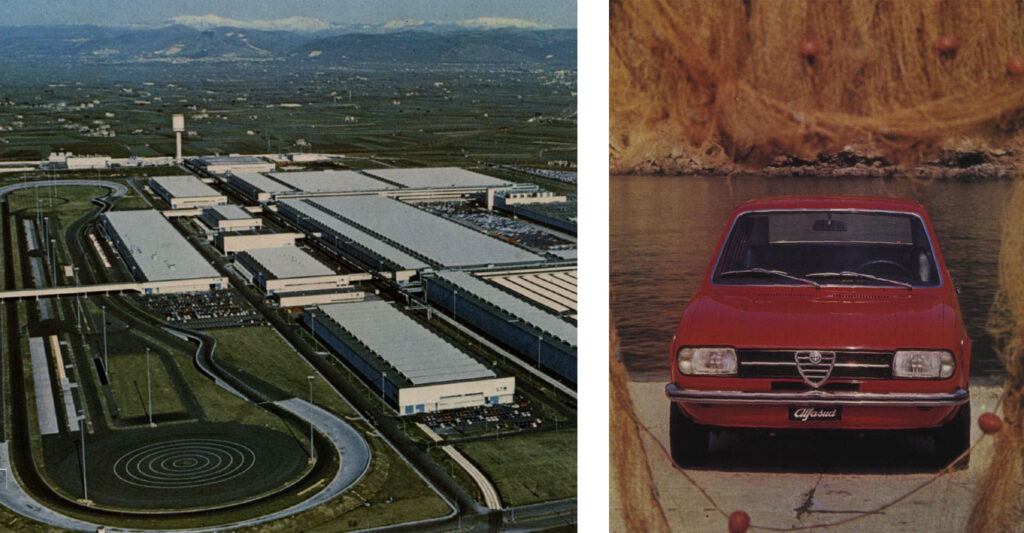
Left: Aerial vision of the Pomigliano d’Arco (near Naples) plant built by Alfa Romeo in the early 1970s. Right: Alfa Romeo Alfasud. Source: Finmeccanica Annual Report 1971-1972

Energy technology

Building on existing capabilities in manufacturing electrical-engineering equipment such as transformers and substations, Finmeccanica developed deep specialisations in power plant engineering, including nuclear. Organised around the company Ansaldo from the mid-1960s, these activities directly reduced Italy’s foreign energy dependence at a moment when existing hydroelectric plants could no longer keep pace with the electricity demands of a rapidly growing economy. Beyond supplying the industrial equipment that Italy’s energy system required, Ansaldo actively pushed the technological frontier in electricity generation, building the world’s first solar thermal power plant to deliver electricity to a national grid.

Figure 4: Through Ansaldo, Finmeccanica Supported Italy’s Electrification and Energy Independence.
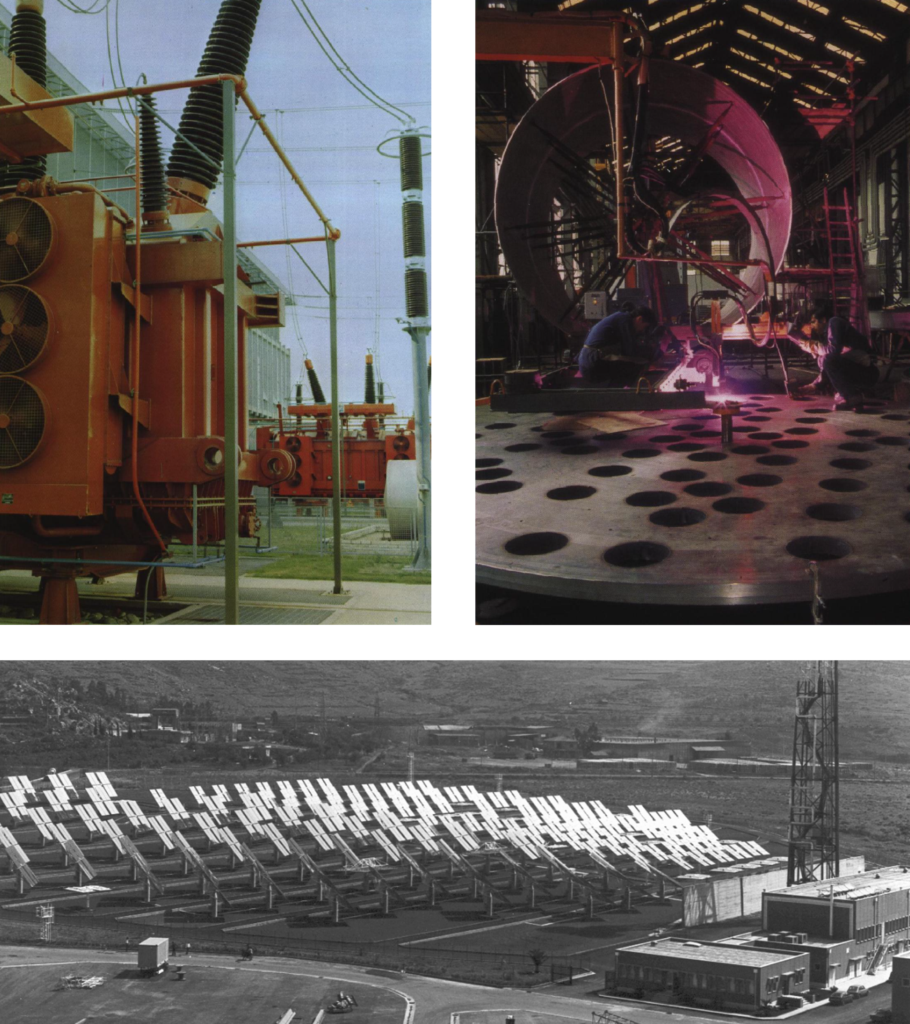
Top Left: 370 MVA transformer for power transmission. Top Right: construction of a nuclear power plant. Source: Finmeccanica Annual Report 1971-1972.
Bottom: “Eurelios”, the world’s first solar thermal energy power plant (1981). Source: Enel Green Power

Civil aerospace

In 1969, Finmeccanica and Fiat established Aeritalia as a joint venture to consolidate the national aircraft industry — concentrating military production in Turin and relocating civil manufacturing near Naples. From that base, Aeritalia was actively steered toward civilian production starting with a 1978 subcontract for Boeing 767 aerostructures in carbon fibre, then the launch of a venture with France’s Aérospatiale in 1981 to become the world’s leading producer of 50-70 seat turboprop aircraft. Military work continued, and was upgraded through international partnerships, but its share of orders and revenues fell from roughly 90 per cent to an even split with civil aviation by the early 1990s.

Figure 5: Through Aeritalia, Finmeccanica Maintained and Developed Industrial Capacity in Civil Aircraft Production, Including for Space Exploration
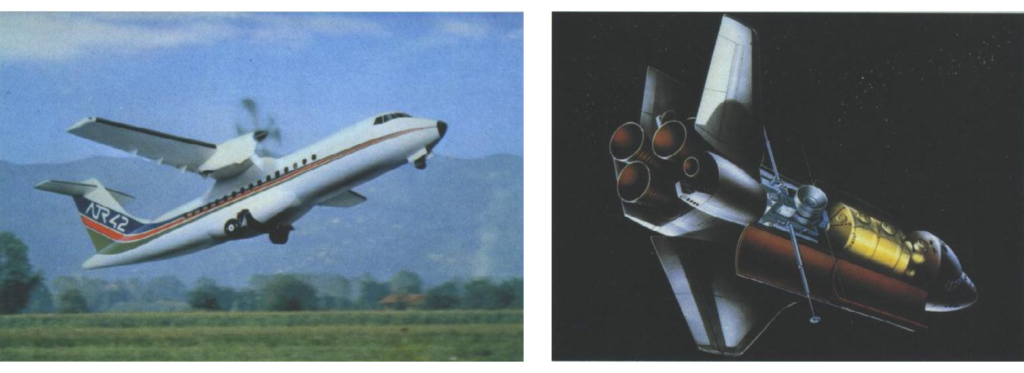
Left: ATR 42 turboprop. Right: Spacelab, the research laboratory used on the Space Shuttle.
Source: Finmeccanica Annual Report 1983.

Towards the 1980s: a publicly owned company for advanced manufacturing

The second half of the 1980s — particularly after the politically induced divestment of Alfa Romeo to Fiat in 1986 — brought another reorientation of Finmeccanica’s public mandate. For most of the preceding decades, mechanical engineering had accounted for 60 per cent of its activities. By the early 1990s, the balance shifted decisively towards high-technology manufacturing, as part of a push to consolidate Italy’s productive capabilities where private investment was lagging. Whereas Finmeccanica’s policy orientation had previously served to redirect capacity towards new civilian purposes, it was thereafter deployed to upgrade Italy’s industrial base. The benefits of Finmeccanica’s high-technology leadership were lasting — industrial diversification and spillovers between subsidiaries made it a platform for Italy’s high-technology manufacturing and economic development.

For instance, Selenia, the radar company, was merged with Aeritalia — creating Alenia — to exploit technological complementarities with aerospace. Elsag, the automation specialist, expanded through targeted acquisitions into industrial robotics, continuous processes and precision measurement, becoming a world leader. And it was under Finmeccanica’s ownership that the semiconductor company SGS-Ates completed its merger with France’s Thomson Semiconducteurs, giving rise to what is known today as STMicroelectronics.

Figure 6: In the Late 1980s, Finmeccanica Doubled Down on Its Specialisation in Air Traffic Controllers, Semiconductors and Industrial Automation.
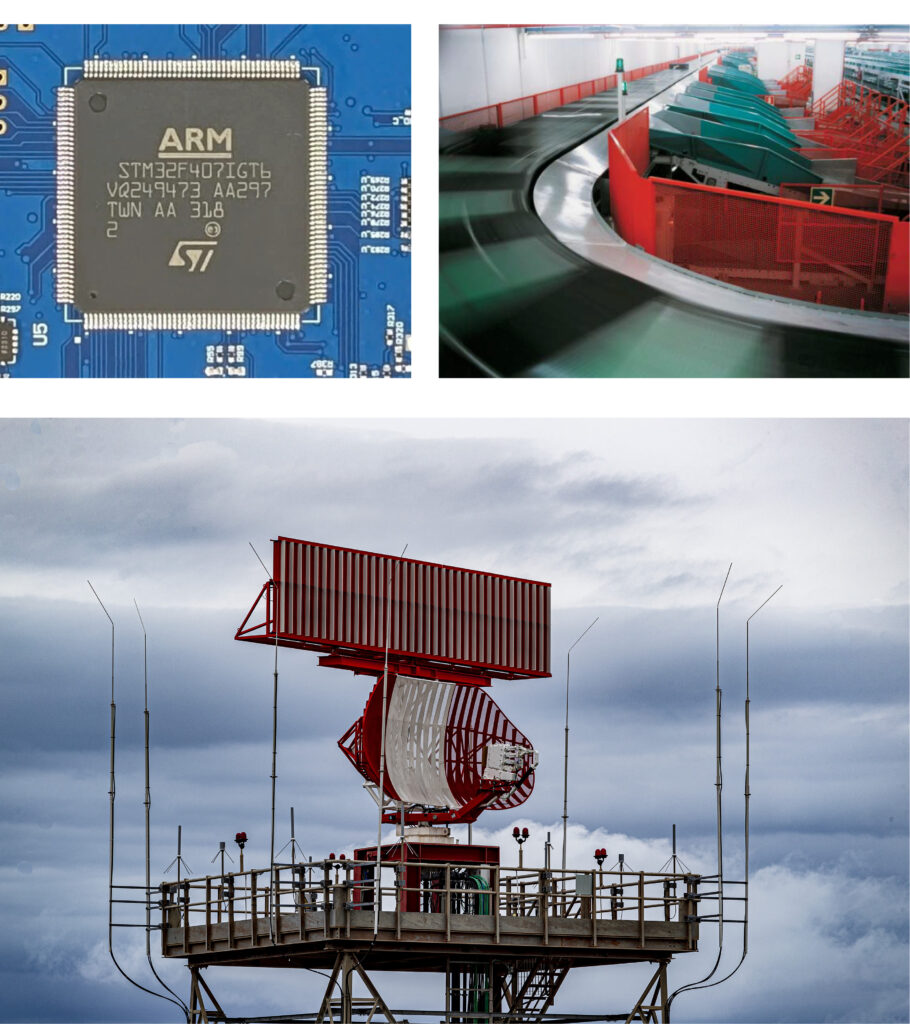
Left: STM32 Microcontroller. Source: STMicroelectronics
Right: Airport automation systems. Source: Elsag Annual Report 2006.
Bottom: ATCR33S air traffic control radar. Source: Leonardo.

Finmeccanica also deepened its presence in rolling stock manufacturing and railway signalling, positioning itself to serve Italy’s decade-long and highly successful investment programme in high-speed rail infrastructure that started in the 1990s.

Figure 7: Through Ansaldo (Trasporti), Finmeccanica Provided the Technology and Rolling Stock Material for a Modern High-Speed Railway Network.
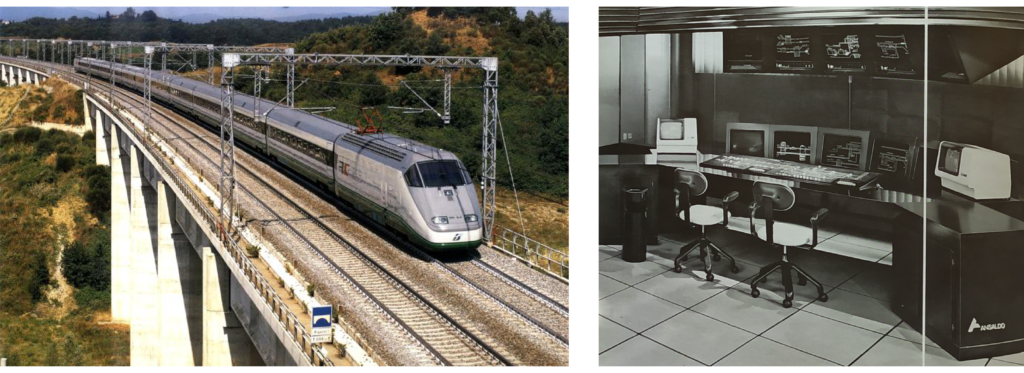
Left: ETR 500 train. Source: Leonardo
Right: Railway signalling controls. Source: Ansaldo Annual Report 1980

Through a series of acquisitions and technology licences as well as building on long-standing capabilities in generators, Ansaldo diversified into turbomachinery by the early 1990s, becoming a global leader in gas turbines at precisely the moment when much of the industrialised world was converting coal and oil-fired power plants to gas.

Figure 8: Ansaldo Energia’s Large-Scale Gas Turbines, Developed Under Finmeccanica, Captured the Global Shift to Gas-Fired Power Generation From the 1990s Onwards.
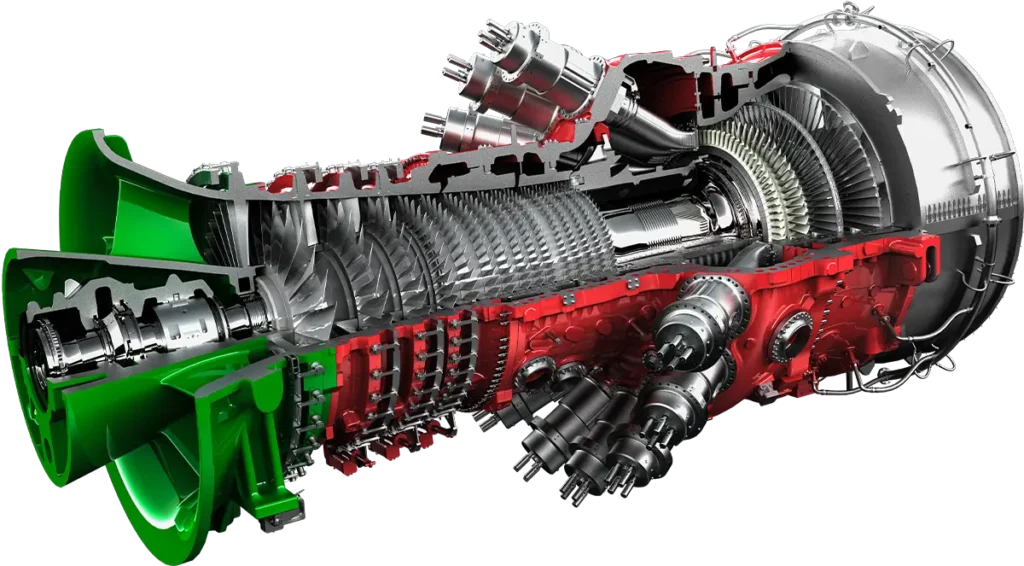
GT36 Turbine. Source: Ansaldo Energia

By 1991, Finmeccanica had become Italy’s most diversified and research-intensive manufacturing group as well as the second largest after Fiat. It employed 56,000 people, the great majority in Italy, while generating 42 per cent of its revenues abroad. It reinvested more than ten per cent of revenues in R&D (compared to Fiat’s 5 per cent). It had become a high-tech group that integrated production and knowledge exchange across subsidiaries. 8 Its competitive standing was reflected in the global rankings and market shares that its leading companies had achieved across a range of product categories (see Table 1).

Through its diversification and high-tech leadership, Finmeccanica left a powerful legacy that has lasted far beyond the transformation of the company itself. The former Alfa Romeo plant near Naples, now owned by Stellantis, is the second largest car-making facility in Italy. Fincantieri is Europe’s largest shipbuilder. STMicroelectronics, though outgunned by its US and Asian rivals, remains one of the few world-class technology companies in Europe. Gas turbines are still produced on Italian soil, with Ansaldo Energia the fifth largest manufacturer in the world. Italy’s railway network still runs on domestically developed technologies and trains produced within the country. Although Finmeccanica no longer exists, the technological capabilities and civilian manufacturing capacity it developed under public ownership remains an asset embedded in the Italian economy.

Becoming Leonardo

The privatisation moonshot

1992 was the beginning of Italy’s privatisations. IRI’s public corporation status was dissolved and the entity converted into a joint-stock company — the first step towards its liquidation and the privatisation of the companies it controlled.

Finmeccanica was an early and prominent target with privatisation calling for financialisaton as the enabling condition. Listed on the stock exchange in 1992, Finmeccanica had to be made attractive to potential financial investors to maximise receipts from its sales. That meant shedding activities with lower profitability — regardless of their broader long-term returns to the Italian economy — and concentrating on the product lines with higher margins.

Military production became the prime candidate — but Finmeccanica’s military-related activities before 1992 were limited to electronic warfare systems (radars) and a handful of international partnerships in military aircraft. Finmeccanica’s military consolidation came through the dissolution of EFIM, a smaller state holding company. Between 1994 and 1996, EFIM’s companies were transferred to Finmeccanica — among them firms making helicopters, armaments, radars and military electronics. IRI, now reduced to a liquidation agency, could no longer challenge the government on its strategy of privatisation. With that decision, Finmeccanica achieved 70 per cent of national defence production capacity, which was previously more dispersed between Finmeccanica, EFIM, the private Fiat Group and other smaller producers.

Despite these transfers, civil revenues still slightly predominated. This hybrid military-civil profile was ill-suited to the privatisation agenda: divesting civil activities could reduce debt and free up capital for acquisitions of foreign military assets, to ultimately deliver a more attractive company for financial investors.

Newly appointed executives in 1997 were given a precise mandate: to push Finmeccanica towards full military specialisation as a prerequisite for completing its privatisation. In a results presentation in 2005, that same management looked back on pre-1997 Finmeccanica as “a classic conglomerate with no focus”. They called 1997 a watershed, and what followed “a remarkable metamorphosis”. 9 In the following years, the company was rapidly transformed.

STMicroelectronics, listed in 1994, was fully divested to fund the acquisition of a 50 per cent stake in AgustaWestland helicopters. Between 1998 and 1999, a still 84 per cent publicly owned Finmeccanica sold Ansaldo Sistemi Industriali and Elsag Bailey Process Automation — leading companies in robotics and automation processes — while expanding military acquisitions.

The ground was now prepared for the decisive step. In 2000, a winding-down IRI fully divested its controlling stake in Finmeccanica, raising €5.5 billion, with the Ministry of Economy and Finance retaining a golden share. After that moment, the company became majority privately-owned. Today, institutional investors account for 50.8 per cent of its shareholding, almost all of whom are domiciled outside Italy.

Abandoning diversification and civilian manufacturing

The remaining businesses in information technology, transportation and energy were rapidly dispatched. IT was repackaged as a security business within aerospace and defence. In 2013, Ansaldo Energia was divested. Hitachi Rail acquired the rail subsidiaries — AnsaldoBreda, manufacturer of the iconic Frecciarossa trains, and Ansaldo STS, a global leader in railway signalling. In 2016, to mark the transformation, shareholders renamed the company Leonardo, now a full-blown military contractor.

The contrast with the pre-1992 period at that point could hardly be starker. Where the IRI-owned Finmeccanica was a conglomerate that grew by diversifying into new sectors and building industrial capacity within national boundaries, 10 the past 30 years have seen only a handful of greenfield investments in new domestic industrial sites. Even those were undertaken not to develop sovereign industrial capability, but to supply components to larger projects overseas — such as fuselage sections for Boeing’s 787 and wing parts for Lockheed Martin’s F-35. The privatisation path that led to Leonardo was instead characterised by acquisitions funded through the divestment of civilian activities and foreign joint ventures designed to consolidate its military specialisation.

A pillar of NATO’s military-industrial complex

As NATO’s military spending has surged over the past decade, accelerating further during the war in Ukraine, Leonardo has concentrated an ever-greater share of Italy’s military capability under its umbrella. 11 The promise of lucrative government contracts is delivering stellar returns to investors. Between 2022 and 2025, as military procurement grew orders by 38 per cent and revenues by 33 per cent, dividends paid to shareholders rose by 275 per cent and the share price increased sixfold. Employment, meanwhile, grew by just 22 per cent — more than half of that through consolidations and acquisitions rather than net new hires. Capital investment rose by 36 per cent, driven primarily by intangible assets rather than new plants, machinery and equipment. 12 This shows how little value from taxpayer-funded military spending trickles down to the real economy, while the bulk of financial gains flows to foreign institutional investors.

At the same time, the terms of Leonardo’s role within the transatlantic military industry have become more exposed. The CEO of Leonardo, Roberto Cingolani, was not reappointed after reported discomfort in Washington over his announcement of an integrated air defence architecture that might challenge US technologies. 13 Similarly, Cingolani refused to purchase Palantir’s software for Leonardo although he did offer a joint venture to co-produce new products. His successor, Lorenzo Mariani, built his career at the missile manufacturer MBDA and is regarded as more closely aligned with the Italian military establishment and its geopolitical posture.

Herein lies the ultimate paradox of the privatisation-cum-militarisation of Finmeccanica. An instrument of civilian industrial policy, created to free Italy from technological dependency, has become a taker of foreign and defence policy required to remain highly profitable at the demand of shareholders.

What Can Finmeccanica Tell Us About Europe’s Militarisation?

Leonardo’s story prefigures what could happen to European manufacturing if the alliance of private finance and militarisation continues to reshape the continent’s industrial priorities. Three lessons bear directly on today’s military industrial transformation.

The first is economic. The demilitarised, publicly owned Finmeccanica served as a policy instrument for industrial development. It operated through diversification into a wide range of civilian manufacturing activities, in response to the needs of national economic policy. Given the breadth and scale of Finmeccanica’s operations, these investment initiatives benefited domestic companies across its supply chain and the wider economy. Specialising in military production, on the contrary, forfeits most of these economic opportunities. Military-industrial specialisation narrows the scope for diversification, locking industrial capacity and workers’ skills into activities with few applications beyond the battlefield. 14

The second is political, and concerns dependency. Military production depends on markets created and sustained artificially by government spending. Ultimately, it relies on sustained political commitment and is extremely vulnerable to international shifts entirely beyond its control. Deprived of the enormous resources now committed to military procurement, the military-industrial complex across Europe would face catastrophic consequences — wasted resources, unemployment and permanent deindustrialisation. This is precisely the predicament that Italy’s mechanical engineering companies faced after the Second World War, before Finmeccanica was established to secure their future in genuinely commercial markets. Civilian production — and the resulting diversification — made the demilitarised Finmeccanica more resilient to external shocks, and its productive assets ultimately safer.

Finally, Finmeccanica’s story offers practical lessons for policy — above all, on the potential of public ownership to address societal needs while driving economic development and technological progress. State holding companies investing in civilian manufacturing with a long-term orientation, freed from the pursuit of short-term profitability, could help revive European industrial competitiveness. New productive capabilities and technological leadership could emerge in public transport manufacturing (trains and electric buses), in electricity infrastructure (cables, transformers) and in heating and cooling equipment — all areas where industrial opportunity meets energy security and climate imperatives. Public demand from government investment could further drive a much- needed industrial renaissance — if the resources now earmarked for extra military procurement were diverted to civilian uses instead.

The example of Finmeccanica should give pause in these changing times. It stands as a warning against betting the future of European industry on an illusory military specialisation — but also as inspiration for the long-term answers to societal needs which public ownership and investment can deliver.

  1. 1.
    “The Ankara Summit Declaration”, NATO, 08/07/2026. Available here.
  2. 2.
    Author’s elaboration on “Defence Data”, European Defence Agency. Available here.
  3. 3.
    “Production in Industry — Annual Data (sts_inpr_a)”, Eurostat. Available here
  4. 4.
    “Top 100 for 2024”, Defense News, 2024. Available here.
  5. 5.
    Marco Versiero, “Trovo modo da offendere e difendere”, La concezione della guerra nel pensiero politico di Leonardo”, Cromohs — Cyber Review of Modern Historiography, 2014, vol. 19, pp. 63–78.
  6. 6.
    Simone Gasperin, “Lessons from the past for 21st century systems of state-owned enterprises: The case of Italy’s IRI in the 1930s”, Structural Change and Economic Dynamics, 2022, vol. 62.
  7. 7.
    Pasquale Saraceno, L’Istituto per la ricostruzione industriale – Iri – III. Origini, ordinamenti e attività svolta, Utet, 1956
  8. 8.
    As testified by Angelo Airaghi, Head of Finmeccanica’s Research Centre in a 1995 Parliamentary hearing for the Italian Senate (9 February 1995).
  9. 9.
    “2004 Results Presentation”, Finmeccanica, 2005. Available here.
  10. 10.
    The evolution of Finmeccanica-Leonardo’s workforce reflects this point. Leonardo currently employs 62,762 people, of whom 61 per cent are based in Italy (38,320 in total). In the early 1990s, barely 10 per cent of Finmeccanica’s 56,000 employees were abroad.
  11. 11.
    The acquisition of Iveco Defence Vehicles in 2025, the joint venture with Rheinmetall for battle tanks, the drone partnership with Baykar, and Edgewing — the initiative with BAE Systems and Mitsubishi to develop a next-generation combat aircraft — have completed its transformation into a pure-play military contractor.
  12. 12.
    “Annual Report 2022”, Leonardo, 2023, Available here; “Annual Report 2025”, Leonardo, 2026. Available here.
  13. 13.
    Silvia Sciorilli Borrelli and Amy Kazmin, “The boss of Italy’s defence champion fell foul of politics — and the army”, Financial Times, 12/05/2026. Available here.
  14. 14.
    David Mowery, an expert in economics of innovation, has argued that the spillovers from military to civil activities are limited to the area of R&D, while the effects of military production — “the effects of war” — on innovation are hard to demonstrate. See David C. Mowery, “Military R&D and Innovation” in Bronwyn H. Hall and Nathan Rosenberg (eds.) Handbook of the Economics of Innovation, Volume 2, North-Holland, 2010, pp. 1218ì9.1256.