1
11
21
31
40
41
41
42
43
44
45
46
47
48
49

Labor of the US Military-Industrial Complex

Jobs in the military industry have declined even as the Pentagon budget soars, exposing a broken industrial model.

Executive Summary

Politicians and arms industry executives often justify increasing military spending — which in the United States has surpassed $1 trillion annually — as an economic stimulus that creates good jobs. But the reality is that despite government spending that surpasses Cold War-era peaks, workers at private defense contracting firms find themselves in a declining industry when it comes to job creation and economic mobility. In the mid-twentieth century, workplaces in the arms industry included vast manufacturing facilities with unionized workforces that earned generous pensions, often vaulting low-income Americans into middle-class stability. But the nature of the military-industrial complex has changed significantly since the Cold War, and emerging trends in the industry threaten to exacerbate conditions that have led to stagnant job creation and lower salaries. The capital-intensive nature of weapons production makes military spending one of the least effective ways for the federal government to create jobs. The rise of venture-capital backed defense-tech companies that aim to produce “attritable” weaponry in lean and automated factories will likely make this worse. At the same time, these trends across the sector present an opportunity to convert military production and public investment toward civilian sectors that not only generate more jobs but also greater social returns — including urgent national priorities like green manufacturing and the energy transition.

Key Findings

  • Employment at military contractors has plummeted over the past three decades: from an estimated 3.2 million workers during the Reagan military-spending peak in the mid-1980s to 1.1 million workers in 2020. The drop occurred despite Pentagon budgets rising 22 percent over the same period 1
  • Inflation-adjusted average salaries dropped from $100,500 to $80,243 over the same period despite jobs in the sector becoming increasingly white-collar. 2 This indicates a particularly sharp fall in wages for the blue-collar workforce. Major military industry contractors cut pensions for workers following the 2008 financial crisis — creating a new generation of employees with more economic insecurity, high turnover, and diminished company loyalty.
  • An estimated 10 to 14 percent of the 1.1 million jobs in the private military contracting sector are union jobs.
  • Union rates have declined sharply since the Cold War. For example, at least 69 percent of the Lockheed Corporation was unionized in 1971, while the manufacturing sector was approximately 50 percent unionized mid-century. The unionization rate today is 19 percent at Lockheed Martin and as low as 4 percent at Northrop Grumman.
  • Labor unions have historically been, and continue to be an important entry point for dialogue around industry reform and alternatives.

The US military industry spans private corporations, subcontractors, and government bodies that channel hundreds of billions of dollars into weapons production each year. Workers in this sprawling arms industry occupy a wide range of roles in and relationships to the products they make and the wars those products ultimately serve. Hourly workers at Boeing in Missouri, for example, watched coworkers pack rush shipments of munitions destined for the Israeli military even as graphic images of people killed in the Israeli assault on Gaza circulated widely on social media. 3

At Northrop Grumman’s propulsion systems plant in Utah’s West Desert, employees working side by side may be building components that go into launch vehicles that power NASA’s Artemis missions to the Moon, rockets for military or commercial satellite launches, or intercontinental ballistic missiles for nuclear warfare. Workers at a new Pratt & Whitney turbine airfoil plant in North Carolina may largely make parts for civilian aircraft and then, at some point, engine components for the F-35, the final product of which they will likely never see after it’s assembled in Fort Worth or flown over Venezuela or the Middle East.

What these workers share, however, is that they all find themselves in an industry in decline when it comes to job creation and economic mobility. Recent administrations have employed Cold War-like rhetoric to justify increased spending on weaponry and the military each year — including restarting the global nuclear arms race and revamping the 1980s-era missile shield once known as “Star Wars” now rebranded as the “Golden Dome”, still headquartered in Huntsville, Alabama. Yet for workers, much has changed since the Cold War. Once dominated by stable, unionized jobs with clear career ladders, pensions, and upward mobility, the modern military contracting workforce is now increasingly fragmented, non-unionized, and precarious. Subcontracting, automation, and strategic relocations to regions with weaker labor protections have further eroded job security and union power, resulting in high turnover, diminished wages, and fewer benefits. Emerging trends in automation, “attritable” weapons, new defense-tech companies, and corporate consolidation are likely to further undermine organized labor and limit the creation of stable, high-quality jobs. As one Lockheed Martin contractor at the company’s F-16 plant in South Carolina observed about the common portrayal of the sector as a major job creator: “They talk about job creation but they don’t really talk about the quality of the jobs”.

These changes warrant renewed attention to a movement known in the Cold War era as “economic conversion”, which advocated for disarmament alongside the redeployment of the industry workforce for other national priorities. 4 In an era of escalating military budgets and overseas interventions, this framework challenges the assumption that ever-increasing military spending is the only viable source of industrial employment. Labor unions, in particular, have long served as a crucial entry point for these conversations.

Combining stories from the field with data and context from sources like SEC forms, industry bodies, labor archives, and Pentagon reports, this brief analyzes the current state of the arms industry — examining its workforce past and present, and assessing the implications of the changing nature of the companies that make up the sector.

Content Type
Theme

Declining Unionization in the US Military Industry

The Pentagon budget surpassed $1 trillion in 2026, about half of which was paid to private military contractors. Although this represents the federal government’s largest discretionary spending category, contractors in the sector account for remarkably few jobs within an American workforce of 170 million. According to the National Defense Industrial Association, private employment in the arms industry stands at about 1.1 million. 5

Within that workforce, only an estimated 120,000 to 150,000 — about 10 to 14 percent — are likely represented by a labor union. 6 Yet unionized plants continue to loom large for policymakers who justify the $1 trillion Pentagon budget as a boon for job creation. For example, in early 2026, Defense Secretary Pete Hegseth’s so-called “Arsenal of Freedom” initiative included much-publicized visits to unionized arms plants in four states across the US. 7 The largest unionized defense worksites include Lockheed Martin’s Fort Worth aircraft plant (9,300+ workers), which manufactures the Pentagon’s largest current acquisition program, the F-35; Electric Boat in Groton and New London, Connecticut, (5,900+ workers), where a contract for a new generation of nuclear-armed submarines has recently buoyed employment, and two shipyards owned by HII (Huntington Ingalls Industries): one in Newport News, Virginia (10,000 workers) and a second in Pascagoula, Mississippi (4,700+ workers), where the military shipbuilder builds and repairs amphibious ships and destroyers. 8

A handful of major unions organize workers across the defense sector. These include the International Association of Machinists and Aerospace Workers (IAMAW) — the largest in the sector — the United Steelworkers (USW), and the United Automobile, Aerospace, and Agricultural Implement Workers of America, (UAW). White-collar unions are rare, though one notable presence is the Society of Professional Engineering Employees in Aerospace, which represents workers at Boeing in Washington State. 9 These unions have diverse memberships across various sectors. For example, the IAMAW, often seen as synonymous with defense contracting, estimates that only about 10 percent of its 600,000 members are in the defense sector. 10 In other words, the vast majority of unionized Machinists are not in defense contracting and, as noted above, the vast majority of the private defense workforce is not unionized.

Unionization has stagnated or declined at all the “Big Five” Pentagon contractors since the early 1990s. This trend reflects not only long-term changes in the sector but also labor restructuring — including mergers, acquisitions, and spinoffs, which can add new workplaces to a company’s portfolio or remove employees from its payroll, causing workforce numbers to spike upward or downward. The stagnant or declining unionization rates come at a time when those companies greatly increased their revenues from military spending. Unionization has remained stagnant or declined even as these companies’ revenues from military contracts have grown substantially. 11

The density of unionized workers in locations like Fort Worth and Newport News are exceptions within a defense workforce where the vast majority of workers are nonunion and employment has declined by the thousands from historical peaks in the last century. For example, the Metal Trades Council, an umbrella bargaining council for multiple unions at Electric Boat in Connecticut and Rhode Island, reported membership of around 10,000 during a strike in 1988, a number that has since nearly halved. 12 Lockheed Martin’s aircraft plant in Marietta, Georgia, home to the longest-running aircraft production line in history, had nearly 17,000 unionized workers in 1968. 13 Union membership (excluding retirees) now stands at about 1,800. 14

Cold War-era annual company reports provide snapshots of unionization at top defense contractors. 15 According to these reports, in 1971 the Lockheed Corporation, the predecessor to today’s Lockheed Martin, had a workforce that was at least 69 percent unionized. 16 Raytheon, now RTX, had a workforce that was more than 39 percent unionized in 1962. 17 The Machinists union alone had 100,300 members in the defense industry in 1975, working across both governmental and industrial projects. 18

Multiple trends affecting labor unions in particular and the defense industry as a whole have driven down unionization in the sector. These include automation, subcontracting, anti-union campaigns, and evolving political calculations about scattering jobs across Congressional districts to garner political support. For example, Machinists at the Lockheed Martin aircraft plant in Marietta, Georgia describe their mid-century heyday as a time when raw materials came in one side and aircraft flew out the other. 19 Today, the vast subcontracting web for the Pentagon’s largest acquisition project, the F-35, splinters work on that aircraft across 47 states. 20 Subcontracting also occurs within the plant itself. Union leaders in Marietta recently reported a Lockheed Martin labor negotiator telling them that the company aimed to subcontract any job that doesn’t involve touching the plane, such as previously direct-hire union positions in warehousing and firefighting. 21

The dispersal of facilities across the country also provides companies an opening to favor “right-to-work” states where local laws undermine collective bargaining. An analysis of more than one hundred announcements of corporate expansions and relocations between 2010 and 2022 for the top five defense contractors showed that they favored “right-to-work” states over union-friendly ones by a factor of about 1.5. 22 Recent relocations include RTX’s new Pratt & Whitney parts plant in Asheville, North Carolina, which the company says will grow to over a thousand workers in a blow to its long-standing unionized workforce in Connecticut. 23 In 2017, Lockheed Martin moved its F-16 production line from a unionized site in Fort Worth, Texas to South Carolina. 24 The move makes it the only fighter jet produced at a non-union shop in the US. These geographic shifts occur alongside structural shifts in the industry. Military contractors have become increasingly white-collar, a class of workers less likely to join labor unions since many may be on track to join management. In 2024, Lockheed Martin reported that 57 percent of its workforce were engineers, scientists and information technology professionals, compared to just 13 percent in 1970. 25

At the same time, the capital-intensive nature of the industry (e.g. fighter jets and intercontinental ballistic missiles) also works against job creation and subsequent union strength. The post-Vietnam shift toward high-tech, capital-heavy production, as scholar Corey Payne argues, reshaped war-making in part to curb workers’ power. 26 This pattern is reflected in job-creation data: economist Heidi Peltier has calculated that military spending is one of the least effective ways to create jobs, since more money is needed to go toward capital expenditure like manufacturing equipment or specialized software and less is left for salaries for labor. For every $1 million invested, the defense industry creates roughly seven jobs, compared with 10 in clean energy or infrastructure, and even more in labor-intensive sectors such as healthcare and education. 27

The Nonunion Majority: Fractured Workplaces and Falling Wages

The erosion of stable, unionized employment in the defense sector has reshaped the workforce in ways that undermine worker power. For Cold War-era economic conversion activists — those seeking to reduce dependence on military spending and redeploy that workforce for other national priorities — labor unions such as the Machinists, were a key partner. However, contemporary efforts to pursue economic conversion must contend with the largely nonunion nature of the industry and the increasing transience and turnover of its workforce. For example, retired Machinists in Marietta, Georgia describe spending two to four decades at the company — motivated by their economic mobility within Lockheed and the ample pension they worked toward. 28 But since 2011, new hires in Marietta, Georgia no longer earn pensions, a common trend across the industry, with similar pension losses impacting hourly workers at Electric Boat since 2010, at Lockheed Martin in Fort Worth, Texas since 2012, and Boeing workers in Missouri after 2014. 29 Union staffers in Marietta complain that turnover now outpaces hiring. The aerospace and defense sector had a 13 percent turnover rate in 2023, compared to the nationwide average of 3.8 percent. 30

Work in the defense sector is increasingly fractured and disjointed, with management entrenching divisions between workers classified as skilled versus unskilled and separating employees by categories such as direct hires and contractors. These divisions drive high turnover, as low-wage roles are treated as interchangeable, and workers are given little reason to remain loyal to employers who view them as expendable while still exposing them to significant risk. The elimination of pensions, for example, creates a generational divide in the workforce, with older hires grandfathered into better compensation and new hires resenting that their older peers voted in favor of contracts that deny them the same benefits. A worker at nonunion Lockheed Martin’s aircraft plant in Greenville, South Carolina, which produces F-16s for foreign militaries like Bahrain and Slovakia, explained:

Contracting is common in aviation – the majority of people start off as contractors and then go to direct hire for a company like Lockheed. They say they are testing you out, but really it is a way of keeping the full employees in check: “Hey, look how easy it is to get new people”, when you go direct, you take a pay cut. The use of contracting is a way of keeping union organization efforts in check.

Even at major weapons plants flush with government contracts, nonunion hourly jobs can be remarkably precarious, resembling low-wage jobs in other sectors of the American economy. A nonunion engineer at Northrop Grumman’s missile plant in Utah’s West Desert, which will manufacture more than 600 Sentinel intercontinental ballistic missiles for the Air Force in the coming years, explained:

I heard some disgusting comments from our site director about our operators who build our rocket engines on the floor. He said that he wants our process engineer to write the planning in a way that anyone plucked off the street can understand it and put pieces of a rocket together. Having operators and machinists be able to understand drawings is an essential part of the industry because it opens greater communication between engineers and operators. But the site director was complaining that in terms of the labor market, “we’re competing with McDonald’s”.

Declining pay is also a defining feature of the modern military-industrial workforce, particularly for hourly and blue-collar employees. Between the 1980s and 2020, as total employment in the sector fell from 3.2 million to 1.1 million, inflation-adjusted average salaries dropped from $100,500 to $80,243 — an especially striking shift given the industry’s increasingly white-collar composition, which would typically drive wages higher. 31 Although more research is needed to look comprehensively at hourly worker wages across the sector, evidence from the field suggests that blue-collar hourly workers bear much of the brunt of that falling compensation. During a 2025 strike at Boeing’s aircraft and munitions plants in and around St. Louis, Missouri, unionized workers reported entry-level wages as low as $17 an hour. Machinists described relying on food banks to feed their families despite their full-time employment, and a missile inspector reported earning a higher hourly rate driving for Uber while on strike than his regular job at Boeing. 32

Similar patterns appear at venture-capital backed defense tech companies like Anduril, which announced in 2025 that it would build a new factory for autonomous weapons in rural Ohio, a project hailed by the state’s governor as the “largest single job creation” project in Ohio history. 33 The company claims the factory will eventually employ 4,000 people. Buried in the fine print of the company’s contract for property tax exemptions is a remarkably low wage requirement for the rural Ohio plant: an average of $21.75 an hour for all employees across the plant, meaning high-wage managers can offset low hourly pay for manual laborers. 34 Such stories are not anomalous and employment in the sector is not the ticket out of poverty it is often assumed to be. Research shows that roughly half of the most defense-dependent counties have poverty rates exceeding the national average. 35

Emerging Trends: Undermining Organized Labor and Job Creation

The shape of the military-industrial complex is shifting. Even as the second Trump administration vows to raise Pentagon spending by an astonishing 50 percent — ratcheting the annual budget from $1 trillion to $1.5 trillion — several trends underway in the industry are likely to nonetheless work against organized labor in the sector, continuing downward and stagnating trends in job creation and union strength.

One factor is the nature of the weapons projects themselves. Trump’s flagship defense initiative is the Golden Dome — a revival of the 1980s “Star Wars” Strategic Defense Initiative (SDI) which, together with the nuclear arms race, propelled military spending to historic highs during that decade. The Golden Dome seeks to develop and deploy a missile shield over the United States that would intercept incoming weapons, supposedly rendering the United States immune from a nuclear attack. Pentagon watchdogs and even Star Wars engineers themselves have long decried such a missile shield as a technologically unfeasible fantasy weapon. 36 But the Reagan-era program was a boon to defense contractors, particularly their white-collar workforce. As historian Michael Brenes has written: “High-tech areas in the western region of the country benefitted the most from investment in SDI. The missile defense shield remained an experimental and untested program, which meant that most of the jobs for SDI went to skilled engineers, mathematicians, and physicists”. 37

Trump’s similarly named Golden Fleet, a new class of battleships the Trump administration claims will be 100 times more powerful than previous battleships and larger than any others worldwide, may play out similarly. If such an ambitious project came to full-rate production, it could be a boon for the shipyard unions in states like Mississippi and Virginia. But this is unlikely to happen even if state spending surges — the proposal has been widely criticized, including by the hawkish Center for Strategic and International Studies, which it said will “never sail”,  spend years in the design phase, and that “[a] future administration will cancel the program before the first ship hits the water”. 38

Another trend is the rise of defense contractors coming out of Silicon Valley venture capitalism. 39 Most prominent among new entrants to the field are Anduril, Palantir and SpaceX, which vary from the likes of Northrop Grumman and Lockheed Martin since they have their origins in Silicon Valley — and venture capitalists bring with them right-wing politics and alliances. That differs, to some extent, from the more conventional defense contractors that came of age during what historian Brenes calls the “Cold War coalition” of labor unions and Democrats, along with arms industry executives, military leaders, and hawkish anti-communist conservatives. 40 Anduril’s founder Palmer Luckey is a Trump fundraiser and major donor to Trump-aligned congressional candidates. 41 Palantir and SpaceX, which formed a consortium with Anduril to jointly bid on defense contracts, similarly have their origins in billionaire fundraisers Peter Thiel and Elon Musk, whose track records suggest a hostility to organized labor and workplace protections. All three companies have zero labor unions among their US-based workforces. Musk’s SpaceX successfully sued the National Labor Relations Board to allow a president to hobble the agency by firing its members, undermining the enforcement of national labor law, and Musk himself famously oversaw the mass firings of federal employees as head of the so-called Department of Government Efficiency (DOGE). 42 To be sure, Democrat lawmakers have long enabled and even championed high Pentagon budgets. But the rightward trendline in the US arms industry presents a window of opportunity for advocates and constituents to push Democrats and liberal organizations to the left on the Pentagon budget.

The Pentagon and defense tech sector’s push for so-called “attritable” weapons (e.g. drone swarms designed to be expendable in battle) also threatens to double down on the capital- intensive nature of the industry, which, as previously discussed, is a chief reason why defense spending creates fewer jobs than similar investments in sectors like healthcare or infrastructure. Emerging military tech firms are leveraging their ample financial resources and influence to lay the groundwork for a new vision of the military-industrial complex. Palantir, together with other defense tech companies and venture capitalists, launched the New American Industrial Alliance, a lobbying group advised by Trump officials and promoting deregulation and the dismantling of environmental protections while making policy recommendations that target the Pentagon budget. 43 Shana Marshall, an academic specialist in the arms industry, describes their vision of weapons production as incorporating features such as just-in-time production and distributed supply chains similar to those in the garment industry. She observes: “The visions of these CEOs for the future of the [military-industrial complex] in many ways mimics what we’ve seen in other sectors. In addition to outsourcing as much production as possible, there was an emphasis on removing human labor to the greatest extent possible with automated factories”. 44 Military manufacturing startup Hadrian epitomizes that vision — the company claims it will erect 10 to 20 mega-factories that serve prime US defense contractors, utilize robotics, and artificial intelligence to produce parts with “10 percent of the labor normally required”. 45

“The Empty Pork Barrel”: Attempts to Counter Economic Dependence

Amid declining unionization and shrinking employment in the military-industrial sector, workers have an opportunity to pursue economic conversion — redirecting skills, infrastructure, and public investment from military production toward socially beneficial industries. Labor unions, in particular, have long served as a crucial entry point for dialogue around industry reform and alternatives, in part because their members are not subject to at-will employment and are able to publicly express views at odds with their employers without risking being fired over speech. 46This creates a critical window for workers and their unions to advance shared economic and social priorities — and there are powerful examples of labor leaders taking action in this exact way.

In fact, one of the most charismatic and persuasive advocates for curbing the arms race and redeploying the industry’s productive capacity toward alternative civilian needs was none other than the most celebrated president of the Machinists: William Winpisinger, a Navy veteran who helmed the union in the final decade of the Cold War. The self-described “seat-of-the-pants socialist” called for an end to the arms race with no timidity. The divergence of the spiraling Reagan-era military budget from the fortunes of everyday Machinists and working-class people led Winpisinger to promote worker-led economic conversion. Winpisinger even joined the board of the National Commission for Economic Conversion and Disarmament — a group of economists, labor and business leaders, and public officials —as well as co-chairing the National Committee for a Sane Nuclear Policy (SANE), the flagship national nuclear disarmament pressure group.

Under Winpisinger’s direction, the IAMAW communicated to their members that the United States’ outsized military spending hurt them through inflation and cost them jobs that would otherwise be created in civilian industries with more balanced federal spending. The union argued that Pentagon spending drove up inflation by pumping dollars but not consumable goods and services into the economy. 47 Siphoning off scientists and researchers for weapons projects slowed technological progress in civilian industries that then flourished in places like Japan and Western Europe, Winpisinger argued. The union pointed the finger at profiteering corporations and their hawkish allies. “After more than 30 years and $1.8 trillion the Pentagon has enough hydrogen bombs to blow up the world several times over”, Winpisinger wrote in a one-pager published by a peace group. “But each year the brass comes up with a new list of ever more sophisticated, complicated and expensive weapons it must have”. 48

A report commissioned and published by the IAMAW in 1979 laid out net job losses by state when the Pentagon budget increased at the expense of sectors that employed high concentrations of Machinists like construction, local government, and civilian goods manufacturing. Its cover graphic presented a blunt message: as military spending climbs, Machinists jobs decline. 49
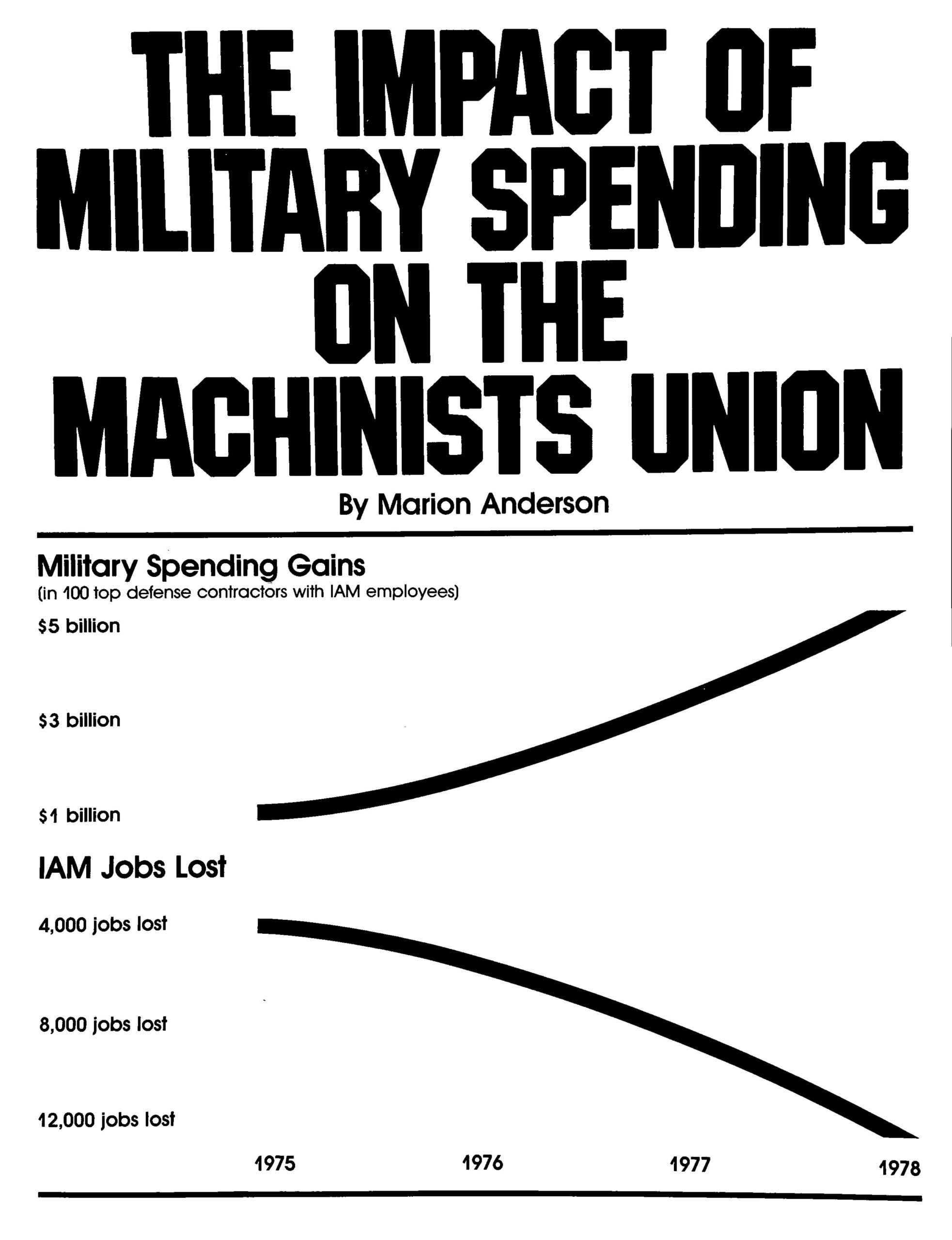
In 1978, a journalist asked Winpisinger how he could make such arguments in light of his own union’s apparent dependency on the defense sector: “How have you justified to a membership, many of whom are employed in military production, your proposals to restrict the production of military hardware? Wasn’t that a pretty tough thing to do?” To which Winpisinger responded:

Yes, it was. And frankly, at the outset I didn’t know exactly how it would go over. But I learned a long time ago that the members of this union will seldom make a decision that’s wrong if they have full exposure of the facts and full access to the information. So I just made an attempt to go out and tell them the facts and propose a remedy. … I reject the idea that the only way to spend less on defense in the future is spending like an SOB [son of a bitch] in the present. The future never comes. Do arms increase world tensions or don’t they? 50

Winpisinger and his union’s populist and critical stance was emboldened by labor allies in politics. Senator Ted Kennedy referred to the jobs foregone in Pentagon spending as “The Empty Pork Barrel” in a 1978 report on jobs foregone by increased military spending. 51 In a 1984 address to SANE, Winpisinger argued that diverse coalition — racial minorities, women, the working poor, chronically unemployed middle-class unionists pushed out by capital, and young underemployed professionals — were all “victimized and brutally assaulted by the warfare state”, and could quickly recognize how massive military budgets and militarization of civilian life undermined their economic, social, and democratic prospects. 52 In his vision, if these groups came together with disarmament advocates around shared leadership, responsibility, and material progress, they could fundamentally challenge the military-industrial order. Yet, Winpisinger’s vision of economic conversion did not materialize during the immediate post-Cold War years, in which national budgetary choices prevented a peace dividend from materializing. Policy scholar Miriam Pemberton, who knew Winpisinger in her role as the director of the National Commission for Economic Conversion and Disarmament, observed that conservative priorities of deficit reduction trumped swords-into-plowshares reinvestment in that period: “During the campaign Clinton promised a dollar-for-dollar reinvestment of defense funds into the civilian economy. That didn’t happen. … 85 percent of the cumulative defense savings during the post-Cold War period, amounting to about $116 billion, went into deficit reduction”. 53

Winpisinger died in 1997, but his ideas continue to animate segments of the modern-day defense workforce. In 2021, for example, David Story, a Machinists local president in Alabama who built rockets for the military at United Launch Alliance, authored an op-ed, “I’m a Defense Worker. It’s Time to Cut the Pentagon Budget”, he wrote:

I’m not advocating getting rid of the defense industry entirely. Just cutting it down to the real size that’s needed for our actual defense and spending the rest to help make sure we’re safe from the imminent threats of climate change, unemployment, and an economy that caters to the interests of the few. … The next time a politician claims that they’re funding endless war for the sake of jobs, we defense industry workers must stand up and say, “Not in our names” 54

Research similarly finds that workers in the sector hold diverse attitudes toward decarbonization and “just transition” to environmentally friendly industries. 55These debates also surface on the shop floor: as daily images of carnage from Israel’s bombardment of Gaza filled social media users’ screens across the US, a military veteran and hourly Boeing employee in Missouri addressed his fellow union members in a shop that is a key supplier to the Israeli military. This drew both angry pushback and commendations from coworkers who said he was “spitting the truth”. 56

The Machinists union commissioned a detailed assessment of its membership and a climate jobs roadmap for the union in 2024, an effort driven by retired defense contractor John Harrity, a former Pratt & Whitney employee. The union’s executive council had recommended against voting for his first climate proposal in 2016, fearing that it would alienate members in fossil fuel-dependent industries. But after Harrity delivered a stirring speech recalling his union’s one-time hesitancy to endorse the civil rights movement because of its mostly white membership or its reluctance to condemn workplace secondhand smoke because it represented tobacco workers, the proposal passed 605 to 500. 57Harrity went on to become the de facto labor representative to his home state of Connecticut’s myriad efforts to green its economy.

The national political climate of Winpisinger’s era bears parallels to today. The first Reagan administration launched an assault on job security and organized labor similar to the mass firings carried out by DOGE in 2025. Winpisinger said his biggest regret in his career was not standing with striking air traffic controllers in 1981 when the Reagan administration dealt a famous blow to them and the broader labor movement by firing them from their federal jobs — a move now widely seen as the opening salvo in a long-running union-busting and anti-labor campaign that continued during Reagan’s time in office. 58 Contemporary US policies, including support for Israel’s genocide in Gaza and the hyper-militarization of federal immigration raids in US cities, have become defining experiences for a new generation of critics of American policy., This echoes the impact of the Vietnam War and the nuclear arms race of Winpisinger’s generation. At the same time, inflation and affordability have emerged as pressing concerns for American voters, further shaping public discontent.

Labor unions have long served as vital entry points for dialogue around industry reform and alternatives, in large part because unionized workers are not subject to at-will employment and cannot be arbitrarily fired over speech. Modern efforts to build coalitions like those of the Winpisinger era, however, must also account for the vast nonunion majority of the defense workforce, with its high turnover and fractured subcontractor networks. Even so, Winpisinger’s candor with his colleagues at SANE illustrates that the workforce of the arms industry can and should be a key participant in broader civil society movements aimed at disarmament, curbing the excesses of the military-industrial complex and redeploying national resources to address urgent national security risks such as climate change. In the decades since Winpisinger oversaw the Machinists, the military industry has offered even less to those that it employs. Despite the growth of war spending and the expansion of the Pentagon budget, the window of opportunity to collaboratively pursue alternatives is now that much more open — and that much more urgent.

Policy Directions

1

Cut the military budget

The roughly $1 trillion Pentagon budget is not only bloated relative to domestic needs, it reflects a decades-long strategy of global military primacy, sustained through extensive overseas deployments, a global network of bases, and repeated interventions. Reducing military spending is a necessary step toward shrinking the global footprint of the US military and building avenues for multilateral cooperation needed to solve global challenges. Numerous policy proposals and precedents exist, including reviving the Cold War-era Renegotiation Board that reviewed defense contracts for excess profits and returned excess to the US Treasury, or requiring the Pentagon to pass an audit before additional funding is allocated. 59

2

Redirect military-industrial capacity to meet urgent needs

Redeploy the productive capacity that has been tied up in war spending for decades toward climate mitigation, green manufacturing, and care sectors that create more jobs and provide broader social benefits. 60As the Machinists union wrote in their landmark green jobs report: “Combating climate change is a massive undertaking, but the IAM is poised to push for solutions that protect our planet while building union power. … Union-led climate action can honor the legacy of North American manufacturing while transforming it to protect people from the climate crisis”. 61

3

Invest in a just transition for arms workers

Undertake public investment in strategic arms conversion programs to build a new industrial policy for socially useful green manufacturing with secure employment for workers currently dependent on the military sector. Policies should prioritize retraining, wage guarantees, and social protections for workers affected by reductions in military spending and to support workers in developing alternative plans. Strengthening organized labor — including union representation, collective bargaining, and worker participation in industrial planning — will ensure that the transition benefits workers and protects jobs. Broader social investments can support regions dependent on military contracting and ensure that the benefits of transition are widely shared. Successful “swords into plowshares” initiatives have been uncommon in the United States, due to limited policy support, but successful examples do exist. 62

4

Curb the influence of the military-industrial complex

Reduce the power of military contracting firms over US policy. In recent years, the US has invested over twice as much in just five major weapons companies as in diplomacy and international assistance. 63Because the sector depends so heavily on government spending, contractors engage in extensive lobbying, maintain revolving-door relationships with Pentagon officials, and funnel tens of millions of dollars in campaign contributions to key members of Congress who oversee military budgets. 64 These practices allow corporate interests to dominate policy decisions — prioritizing profit over the public good.

5

Oppose state and local subsidies to the arms industry

End state and local economic development incentives that subsidize defense contractors already funded by federal spending. This is a key arena to challenge the de facto industrial policy of endless war at the local level. 65State and local subsidies for defense contractors represent a form of “double-dipping”, since the companies receive revenue from the federal government and grants and tax kickbacks from local ones. Anduril’s planned Ohio mega-plant, for example, is set to receive at least $848 million in state and local subsidies. 66

Acknowledgments

With thanks to Bill Hartung, Jennifer Greenburg, John Harrity, Miriam Pemberton, Priyanka Mohanty, and Rebekah Diski for their review and feedback.

Appendix

Author’s note on methodology

I started off with an estimate of the private defense contracting workforce of 1.1 million workers in 2020, which I drew from the National Defense Industrial Association’s “Vital Signs” report. 67 The plausibility of their estimated workforce size is bolstered by figures reported in top contractors’ Securities and Exchange Commission forms 10-K, annual reports of business conditions published by the “Big Five” defense contractors, which are all publicly traded companies and therefore file forms 10-K. Those reports do not distinguish between employees whose jobs derive from defense contracts and those who work on other government contracts or for commercial clients. Such a distinction would often be impossible to make, since many workers have hybrid roles. I therefore multiplied their reported workforce sizes and size of their unionized workforces by their revenue from defense to come up with an estimate of the defense workforce at each company. 68

  • Lockheed Martin 69: Workforce total (121,000) X percentage revenue from defense (96 percent) equals 116,160.
  • RTX 70: Workforce total (186,000) X percentage revenue from defense (54 percent) equals 100,440.
  • Northrop Grumman 71: Workforce total (97,000) X percentage revenue from defense (89 percent) equals 86,330.
  • General Dynamics 72: Workforce total (117,000) X percentage revenue from defense (76 percent) equals 88,920.
  • Boeing 73: Workforce total (172,000) X percentage revenue from defense (48 percent) equals 82,560.

That calculation suggests that those five companies employ an estimated 474,410 workers whose jobs can be attributed to defense contracts. Those companies have accounted for about one third of the annual contracting budget for the Pentagon in recent years. 74 Tripling that figure (1.4 million) roughly corresponds with NDIA’s 1.1 million workforce estimate, the difference likely reflecting those prime contractors having large manufacturing operations that include higher percentages of blue-collar workers.

Those publicly traded companies also report the percentages or numbers of unionized workers they employ. Similar calculations to the ones above offer an estimate of the number of unionized workers at each company whose jobs are attributable to defense contracts:

  • Lockheed Martin (union): 22,900 X percentage of revenue from defense (96 percent) equals 22,070.
  • RTX (union): 34,000 X percentage revenue from defense (54 percent) equals 18,360.
  • Northrop Grumman (union): 4,100 X percentage revenue from defense (89 percent) equals 3,649.
  • General Dynamics (union): 23,400 X percentage revenue from defense (76 percent) equals 17,784.
  • Boeing (union): 58,000 X percentage revenue from defense (48 percent) equals 27,840.

That calculation suggests that those five companies employ an estimated 89,703 unionized workers whose jobs can be attributed to defense contracts.

I could have once again tripled that figure as an estimate for the total percentage of unionized workers at defense contractors among that 1.1 million workforce pool, coming up with an estimate of 269,109 workers or 24 percent. But that estimate is likely higher than the reality, because those five companies likely represent the bulk of unionized workers in the defense sector. Those companies’ dominance of the defense contracting market is due to their ownership of major manufacturing facilities, including shipyards and aircraft plants, that are among the defense worksites most likely to have union representation, with many such unions dating back decades.

Newer entrants to the defense contracting market, such as SpaceX, Palantir, and Anduril have zero unionization among their workforces in the US, including among their manufacturing sites. 75 One notable outlier is a military shipbuilder that derives all revenue from defense contracts, HII (Huntington Ingalls Industries). It is not included among those top five defense contractors but has a high percentage of unionized employees among its workforce, totaling 19,800 union workers out of 44,000 total employees. 76 Other top contractors, in order of their revenue from defense in 2024, report smaller numbers of unionized workers, such as Leidos (265), L3Harris (2,600), Booz Allen Hamilton (0), CACI International (0), and GE Aerospace (3,700). 77 Those companies report revenues from defense contracting that range from 16 to 80 percent. The International Association of Machinists and Aerospace Workers, which identifies as the largest union among defense contractors, estimates about 60,000 of its 600,000 members are in the defense sector, though the union counts retirees as members and some in that number work directly for the federal government. 78

As those numbers demonstrate, there is wide variability in the union activity at top defense contractors, and the largest union sites are the ones that correspond with major shipyards, aircraft or munitions plants. Unionization rates are likely to decrease farther down the list of the tens of thousands of companies that make up the defense industrial base, since companies down the supply chain are mostly small businesses, and small businesses are harder to organize. 79 Percentage revenue from defense also varies widely farther down the list of top contractors, which makes it more difficult to map union activity onto defense spending. To complicate matters more, smaller companies sometimes provide no or vague information about how much of their workforce engages in collective bargaining in their forms 10-K or are not publicly traded.

To estimate union participation for that final two-thirds of the defense industry workforce outside the “Big Five” (1.1 million total workforce minus an estimated 474,410 workers at those companies whose jobs can be attributed to defense contracts, or, 625,590), I used two sets of data. The first is the Office of Local Defense Community Cooperation’s breakdown of defense contract spending by industry type. 80 I then matched each of those categories of spending to their closest corollary contained in estimates of union participation by industry in the Union Membership and Coverage Database from the Current Population Survey, maintained by economists Barry Hirsch, David Macpherson, and William Even. 81

I converted each industry type’s share of defense contract spending into their share of the remaining defense workforce (625,590) and multiplied by the closest corresponding unionization rate.

  • Supplies and equipment accounts for 46 percent of the remaining workforce. At the equivalent unionization rate — Durable Goods Manufacturing (7.6 percent) — this equals 21,870 unionized workers.
  • Services accounts for 40 percent of the remaining workforce. At the equivalent unionization rate — Prof., Scientific, Technical Services (1.7 percent) — this equals 4,254 unionized workers.
  • Research and development accounts for 11 percent of the remaining workforce. At the equivalent unionization rate — Scientific Research and Development Services (2.3 percent) —  this equals 1,583 unionized workers.
  • Construction accounts for 3 percent of the remaining workforce. At the equivalent unionization rate —  Construction (11.5 percent) — this equals 2,158 unionized workers.

To summarize, I used two broad calculations for this estimate. First, I took advantage of the relative precision that the forms 10-K for the “Big Five” offer to calculate the estimated number of union members whose jobs can be attributed to defense contracts. Then, I used broad spending categories and general estimates of union participation in those industries to account for the remaining defense contracting workforce. I came up with a total of an estimated 119,568 unionized workers in the defense contracting industry, or 10.8 percent. This estimate is based on figures and corporate reporting with varying degrees of precision and should be understood as an anchor for an approximate range of unionized workers in the sector, from approximately 120,000 to 150,000, or 10 to 14 percent of the workforce.

  1. 1.
    “Vital Signs”, National Defense Industrial Association, 2021. Available here, comparative budget figures have been adjusted for inflation.
  2. 2.
    Ibid
  3. 3.
    Taylor Barnes, “Workers at Defense Contractors Navigate Dissent over Gaza War”, Inkstick Media, 7 June 2024. Available here.
  4. 4.
    Throughout this briefing, the term “defense” is sometimes used as shorthand to refer to the United States’ military institutions. This term, while widely used by the industry and government alike, is contested and can be misleading in that it obscures the distinction between activities that genuinely protect people and warfare and military actions that often have little to anything to do with defending anyone.
  5. 5.
    While not all jobs neatly fit into the category of defense and some workers have hybrid roles that span the arms industry, other government agencies such as NASA, and commercial work, this employment estimate is both a useful metric to understand job creation within the trillion-dollar Pentagon budget and also aligns with self-reported employment figures from top defense contractors. See Appendix.
  6. 6.
    See Appendix
  7. 7.
    Newport News, Virginia, St. Louis, Missouri, Fort Worth, Texas and Bath, Maine.
  8. 8.
    Workforce estimates are compiled from the following sources: “LM-2 Labor Organization Annual Report for Machinists-AFL-CIO District Lodge 776”, U.S. Department of Labor, n.d. Available here; Brian Hallenbeck, “Draftsmen’s union getting nowhere in contract talks with EB management”, The Day, 2 April 2025. Available here; For HII’s Newport News shipyard see “LM-2 Labor Organization Annual Report for AFL-CIO Local Union 8888”, U.S. Department of Labor, n.d.Available here; for Ingalls Shipbuilding, Pascagoula, see Forms LM-2 or LM-3 Labor Organization Annual Reports for Machinists AFL-CIO Lodge (160 members), Metal Trades Council (3,375), International Brotherhood of Electrical Workers (1,253), “Form LM-3 Labor Organization Annual Report for the Machinists AFL-CIO”, U.S. Department of Labor, n.d. Available here; “Form LM-3 Labor Organization Annual Report for the Metal Trades Council”, U.S. Department of Labor, n.d. Available here; “Form LM-2 Labor Organization Annual Report”, U.S. Department of Labor, n.d., Available here.
  9. 9.
    Boeing’s Washington plant largely produces commercial aircraft but has also manufactured military ones, including the KC-46A tanker and the P-8, a Navy submarine hunter and patrol aircraft.
  10. 10.
    Taylor Barnes, “Union Strength Declines at Top Defense Contractors”, Inkstick Media, 15 June 2023. Available here; Zach Cunningham, Rohan Palacios, Alejandra Rodriguez Diaz, and Lauren M. Burke, “Reclaiming Our Future: A Climate Jobs Agenda for the International Association of Machinists and Aerospace Workers”, 2024. Available here.
  11. 11.
    For example, those top five contractors received about $96 billion in federal contracts in 2002 compared to $141 billion in 2024, both figures inflation-adjusted to 2024 dollars. For more on the upward trend, see: Stephen Semler, “The top 5 military contractors ate $2 trillion during the Afghanistan War”, Polygraph, 23 August 2021, Available here.; William D. Hartung and Stephen Semler, “Profits of War: Top Beneficiaries of Pentagon Spending, 2020 – 2024”, Brown University Costs of War Project and Quincy Institute for Responsible Statecraft, 8 July 2025. Available here.
  12. 12.
    “Workers Strike at Nuclear Submarine Maker”, Associated Press, 2 July 1988. Available here.
  13. 13.
    Austin D. Graham, “Local Lodge 709 Marietta, Georgia, Something To Crow About”, Georgia State University Southern Labor Archives.
  14. 14.
    Form LM-2 Labor Organization Annual Report for Machinists-AFL-CIO Lodge 709”, U.S. Department of Labor, n.d. Available here.
  15. 15.
    This refers to Cold War-era versions of annual form 10-K reports, which are available through the Mergent Archives and do not report comprehensively on union activity, as modern-day reports do, and therefore references to organized labor in the company reports should be understood as a floor with additional union activity possible. Available here.
  16. 16.
    Lockheed’s annual report from that year, accessed via the Mergent Archives, reads: “Overall corporation employment on May 9 was 71,700, lowest in 10 years. … The year 1971 finds Lockheed and much of the aerospace industry engaged in collective bargaining. At Lockheed 32 labor contracts covering approximately 50,000 represented employees will be open for negotiation before yearend.”
  17. 17.
    The company’s annual report from 1962 reports a total workforce of 40,274, and wage increases for 15,000 International Brotherhood of Electrical Workers members, 700 International Association of Machinists, and “several smaller bargaining units.” Raytheon 35th Annual Report 1962, accessed via the Mergent Archives.
  18. 18.
    Marion Anderson, “The Impact of Military Spending on the Machinists Union”, International Association of Machinists Department of Public Relations, January 1979.
  19. 19.
    Taylor Barnes, “When a Lockheed job was (almost) better than a Caribbean romance”, Inkstick Media, 20 February 2024. Available here.
  20. 20.
    Dan Grazier, “Has the Pentagon Learned from the F-35 Debacle?”, Project on Government Oversight, 8 June 2023. Available here.
  21. 21.
    Taylor Barnes. “Union Strength Declines at Top Defense Contractors”, Inkstick Media, 15 June 2023. Available here.
  22. 22.
    Taylor Barnes, “Top Defense Contractors Favor Relocations, Expansions in Anti-Union States”, Inkstick Media, 19 July 2023. Available here.
  23. 23.
    Taylor Barnes, “Special Treatment Lines Defense Giant’s Pockets in North Carolina”, Inkstick Media, 20 November 2025. Available here.
  24. 24.
    Fort Worth, though located in a “right-to-work” state, is a federal enclave where the state law impeding unionization does not apply.
  25. 25.
    Form 10-K for Lockheed Martin Corporation for the fiscal year ended 31 December 2024. Available here; The company’s annual report from 1970 reports a total workforce of 84,600 and that one out of every 7.5 employees was a scientist or engineer. Lockheed Annual Report 1970, accessed via the Mergent Archives.
  26. 26.
    Corey R Payne, “From mass mobilization to neoliberal war-making: Labor strikes and military-industrial transformation in the United States”, International Journal of Comparative Sociology, 3 February 2023, vol 64.
  27. 27.
    Heidi Peltier, “War Spending and Lost Opportunities”, Brown University Costs of War Project, 14 March 2019. Available here.
  28. 28.
    Barnes, “When a Lockheed job was (almost) better than a Caribbean romance”, Inkstick Media, 20 February 2024.
  29. 29.
    “Lockheed Martin Urges IAM Employees to Vote in Favor of New Contract,” PR Newswire, 6 March 2011. Available here; Hallenbeck, “Draftsmen’s union getting nowhere in contract talks with EB management”, The Day, 2 April 2025; Kendra Lyn and Chris Van Horne, “Striking Lockheed Martin Workers Approve Labor Deal”, NBCDFW, 28 June 2012. Available here; Shannon Jones, “Machinists union imposes deep concessions at St. Louis Boeing plant”, World Socialist Web Service, 25 February 2014. Available here.
  30. 30.
    Lindsey Berckman, Ajay Chavali, Kate Hardin, Matt Sloane, Tarun Dronamraju, Steve Shepley, “2025 Aerospace and Defense Industry Outlook,” Deloitte, 23 October 2024. Available here.
  31. 31.
    NDIA “Vital Signs” 2021, National Defense Industrial Association. Available here.
  32. 32.
    Sophie Hurwitz, “The Boeing Strike’s Stopping Jets, But Workers Feel the Pinch”, Inkstick Media, 24 October 2025. Available here.
  33. 33.
    “Governor DeWine Announces New Projects Set to Create More Than $1 Billion in Investments, Including Historic Anduril Project”, 27January 2025. Available here.
  34. 34.
    Minutes from the Pickaway County Office of the Board of Commissioners, 24 June 2025. Available here.
  35. 35.
    According to a study published by Brown University Costs of War Project: “Using data from the Defense Department and the U.S. Census, the author identified the three most defense-dependent counties in each of the twenty most defense-dependent states, and compared their poverty rates to the national average. In nearly half the cases, the poverty rates in these military contracting strongholds exceeded the national average,” see: Miriam Pemberton, “From a Militarized to a Decarbonized Economy: A Case for Conversion”, Brown University Costs of War Project, 26 January 2023.Available here.
  36. 36.
    Taylor Barnes, “A Former Star Wars Engineer Weighs in on the Golden Dome”, Inkstick Media, 21 May 2025. Available here.
  37. 37.
    Michael Brenes, “For Might and Right: Cold War Defense Spending and the Remaking of American Democracy”, University of Massachusetts Press, 2020, p. 202.
  38. 38.
    Mark F. Cancian, “The Golden Fleet’s Battleship Will Never Sail”, Center for Strategic and International Studies, 23 December 2025. Available here.
  39. 39.
    Roberto Gonzalez, “How Big Tech and Silicon Valley are Transforming the Military-Industrial Complex,” Brown University Costs of War Project, 17 April 2024. Available here.
  40. 40.
    Brenes, “For Might and Right: Cold War Defense Spending and the Remaking of American Democracy,” University of Massachusetts Press, 2020.
  41. 41.
    “Corporate Underminers of Democracy 2025,” International Trade Union Confederation, 9-16-2025. Available here
  42. 42.
    Daniel Wiessner, “Musk’s SpaceX, others win US court challenge to labor board’s structure”, Reuters, 19 August 2025. Available here.
  43. 43.
    David Jeans, “Trump Wants Manufacturing Jobs Back. Silicon Valley Is Lining Up To Help”, Forbes, 11 December 2024. Available here.
  44. 44.
    Shana Marshall, “In Silicon Valley, Hegseth is just one link in the brave new kill chain”, Responsible Statecraft, 18 February 2026. Available here.
  45. 45.
    Valerie Insinna, “How startup Hadrian plans to take over the defense manufacturing world”, Breaking Defense, 21 August 2024. Available here.
  46. 46.
    Barnes, “Workers at Defense Contractors Navigate Dissent over Gaza War”, Inkstick Media, Available here.
  47. 47.
    Marion Anderson, “The Impact of Military Spending on the Machinists Union”, International Association of Machinists Department of Public Relations.
  48. 48.
    Winpisinger, William W. “What’s Happening to Our Country? Planned Economic Conversion, Getting Off the Hook of Defense Dependency,” Promoting Enduring Peace Inc., Georgia State University Southern Labor Archives.
  49. 49.
    Anderson, “The Impact of Military Spending on the Machinists Union”, International Association of Machinists Department of Public Relations.
  50. 50.
    Murray Yanowitch, “Uphill All the Way Challenge”, March-April 1978, Georgia State University Southern Labor Archives.
  51. 51.
    Referenced in Anderson, “The Impact of Military Spending on the Machinists Union”, International Association of Machinists Department of Public Relations.
  52. 52.
    William Winpisinger, “Notes for Remarks by William W. Winpisinger, International President, International Association of Machinists and Aerospace Workers”, SANE National Conference, 18 March 1984, Georgia State University Southern Labor Archives.
  53. 53.
    Miriam Pemberton, Six Stops on the National Security Tour: Rethinking Warfare Economies, Routledge: 2023, p 37.
  54. 54.
    David Story, “I’m a Defense Industry Worker. It’s Time to Cut the Pentagon Budget”, The Nation, 19 November 2021. Available here.
  55. 55.
    Karen Bell, Vivian Price, Keith McLoughlin, Mijin Cha, Lara Skinner, Karen Simpson, Rosie Jones, Anita Raman, and Zach Cunningham, “Decarbonising and Diversifying Defence in the United Kingdom and United States: A Workers’ Enquiry for a Just Transition”, The British Academy, July 2022. Available here; Taylor Barnes, “Do Defense Workers Oppose Budget Cuts? Not Quite, Study Says”, Inkstick Media, 17 May 2023. Available here.
  56. 56.
    Barnes, “Workers at Defense Contractors Navigate Dissent over Gaza War”, Inkstick Media. Available here.
  57. 57.
    Taylor Barnes, “Major Defense Industry Union Backs Green Jobs “Just Transition”, Inkstick Media, 25 September 2024, Available here.
  58. 58.
    Taylor Barnes, “Local Politics with the Machinists Union in its Southern Hometown”, Inkstick Media, 11 March 2025, Available here.
  59. 59.
    This list of policy directions adapts: Miriam Pemberton, “7 Ways to Divest from a Militarized Economy,” Peace Economy Transitions Project at the Institute for Policy Studies.
  60. 60.
    Peltier, “War Spending and Lost Opportunities”, Brown University Costs of War Project. Available here.
  61. 61.
    Zach Cunningham, Rohan Palacios, Alejandra Rodriguez Diaz, and Lauren M. Burke. “Reclaiming Our Future: A Climate Jobs Agenda for the International Association of Machinists and Aerospace Workers”. Available here.
  62. 62.
    E.g. Brunswick, Maine, following the closure of its naval base, Taylor Barnes, “America’s Military-Industrial Oligarchy vs. Our Small Towns”, Craftsmanship Quarterly, 2022. Available here ; See also: Pinelopi Gardika, Leela Jadhav and Khem Rogaly, “Green Clydeside: Modelling Military Industrial Conversion”, Transition Security Project, 23 October 2025. Available here.
  63. 63.
    Hartung and Semler, “Profits of War: Top Beneficiaries of Pentagon Spending, 2020 – 2024,” Brown University Cost of War Project and Quincy Institute for Responsible Statecraft. Available here.
  64. 64.
    Ibid
  65. 65.
    See campaigns from New York City and Chicago: Sophie Hurwitz, “How to Demilitarize a Shipyard”, Inkstick Media, 9 March 2026. Available here; Asha Ransby-Sporn and Debbie Southorn, “Let’s Replicate Chicago’s Antiwar Organizing Victory Against Boeing”, Truthout, 17 July 2022. Available here.
  66. 66.
    Anduril Industries Subsidy Tracker, Good Jobs First. Available here.
  67. 67.
    NDIA, “Vital Signs 2021: The Health and Readiness of the Defense Industrial Base”, National Defense Industrial Association, 2021. Available here.
  68. 68.
    Defense News, “Top 100 2025”, Defense News. Available here.
  69. 69.
    Form 10-K for Lockheed Martin Corporation for the fiscal year ended 31 December 2024. Available here.
  70. 70.
    Form 10-K for RTX Corporation for the fiscal year ended 31 December 2024. Available here.
  71. 71.
    Form 10-K for Northrop Grumman Corporation for the fiscal year ended 31 December 2024. Available here.
  72. 72.
    Form 10-K for General Dynamics Corporation for the fiscal year ended 31 December 2024. Available here.
  73. 73.
    Form 10-K for The Boeing Company for the fiscal year ended 31 December 2024. Available here.
  74. 74.
    Luke A. Nicastro, “The U.S. Defense Industrial Base: Background and Issues for Congress”, Congressional Research Service, 23 September 2024. Available here; See also: William D. Hartung and Stephen Semler, “Profits of War: Top Beneficiaries of Pentagon Spending, 2020 – 2024”, Quincy Institute for Responsible Statecraft and Costs of War at Brown University’s Watson School of International and Public Affairs, 8 July 2025. Available here.
  75. 75.
    Neither SpaceX nor Anduril are publicly traded and therefore do not file forms 10-K that report union activity. However, a search on the National Labor Relations Board reports shows no union representation at the companies. Form 10-K for Palantir Technologies Inc. for the fiscal year ended 31 December 2024. Available here.
  76. 76.
    Form 10-K for Huntington Ingalls Industries, Inc. for the fiscal year ended 31 December 2024. Available here.  
  77. 77.
    “Represented employee information”. Available here. Form 10-K for L3Harris Technologies Inc. for the fiscal year ended 3 January 2025. Available here.
  78. 78.
    Taylor Barnes, “Union Strength Dwindles at Top Defense Contractors”, Inkstick Media, 15 June 2023. Available here; Zach Cunningham, Rohan Palacios, Alejandra Rodriguez Diaz, and Lauren M. Burke, “Reclaiming Our Future: A Climate Jobs Agenda for the International Association of Machinists and Aerospace Workers”, The International Association of Machinists and Aerospace Workers and The Climate Jobs Institute (CJI) at Cornell University’s ILR School, 2024, p. 28. Available here.
  79. 79.
    See NDIA, “Total Number of Companies in the US DIB”, Vital Signs 2023, National Defense Industrial Association. Available here.
  80. 80.
    “Most contract funds went to supplies and equipment (such as aircraft, ships, weapons, and parts; 46 percent) and services (40 percent), with research and development (11 percent) and construction (3 percent) comprising the remainder.” Defense Spending by State Fiscal Year 2024, U.S. Department of Defense Office of Local Defense Community Cooperation.
  81. 81.
    Barry Hirsch, David Macpherson, and William Even, “Union Membership, Coverage, and Earnings from the CPS”, Union Stats, 2026, Available here.