5
15
25
30
31
32
33
34
35
35
36
37
38
39
45

Mining for War: Assessing the Pentagon’s Mineral Stockpile

How can the Pentagon's energy transition mineral stockpiles be repurposed toward the green transition?

Executive Summary

Driven by concerns about supply chain vulnerabilities amid escalating great power competition with China, the Pentagon is accelerating efforts to secure access to the so-called critical minerals, which are essential to military industries. Central to this push is a ramped-up effort to stockpile these materials within the Defense Logistics Agency (DLA) National Defense Stockpile. The Pentagon’s expanding demand for critical minerals risks diverting vital resources away from civilian decarbonisation initiatives and accelerating militarised competition at a time when global collaboration is essential for a just climate transition. When industrial strategy is shaped by military and national security priorities, it not only entrenches geopolitical conflict but also distorts pathways for equitable climate action, redirecting public resources and state capacity away from the broader demands of rapid and just decarbonisation. This briefing examines how the Pentagon’s role in mineral supply chains, particularly through stockpiling, challenges the global energy transition.

Key findings:

  • Since the passage of the One Big Beautiful Bill Act, which earmarked billions of dollars to bolster the National Defense Stockpile, the DLA has solicited contracts to stockpile a growing list of critical minerals, including several materials essential to the energy transition.
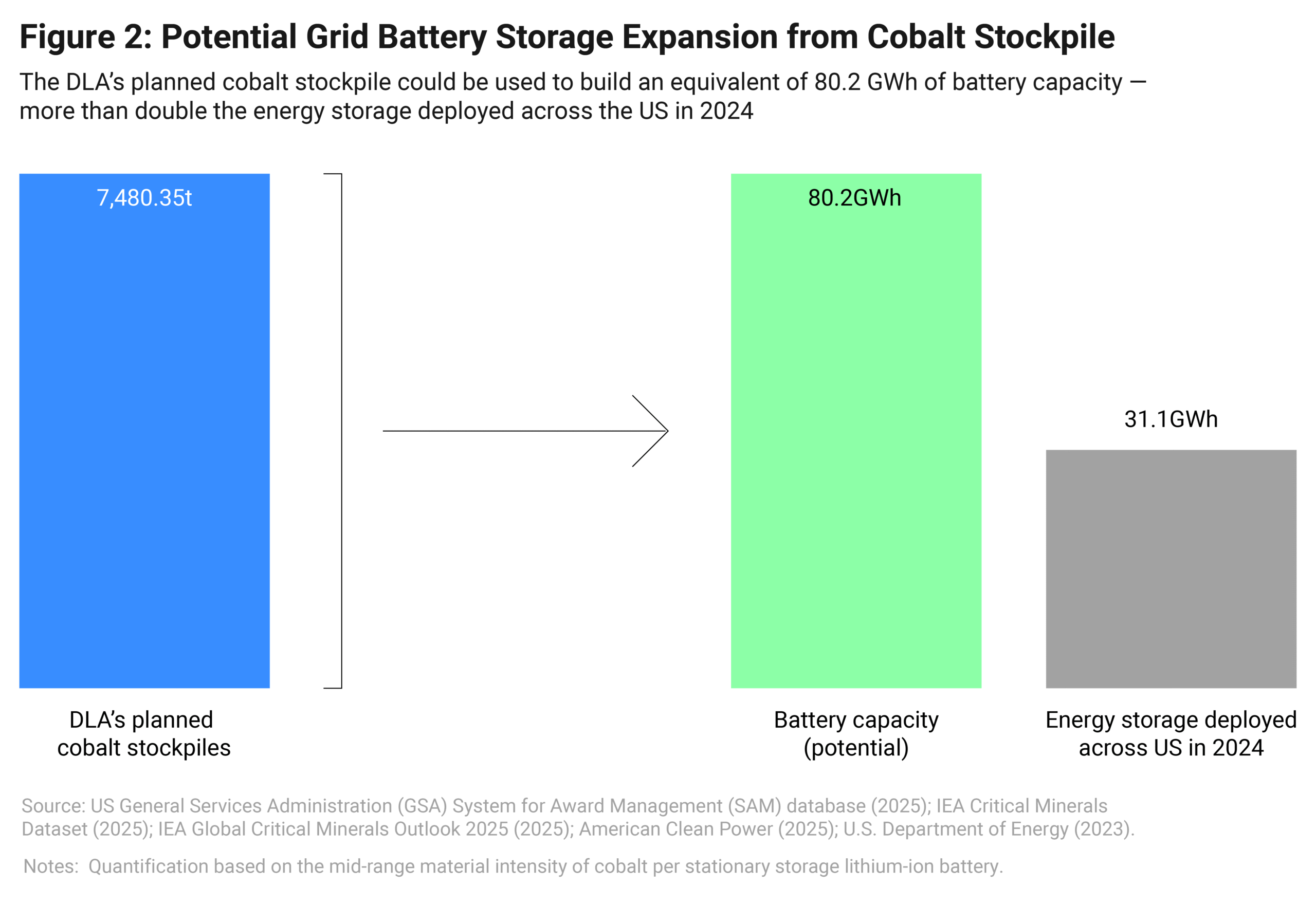
  • The DLA plans to stockpile almost 7,500 metric tons of cobalt. That amount of cobalt could be used instead to produce 80.2 gigawatt hours of battery capacity — more than double existing energy storage.
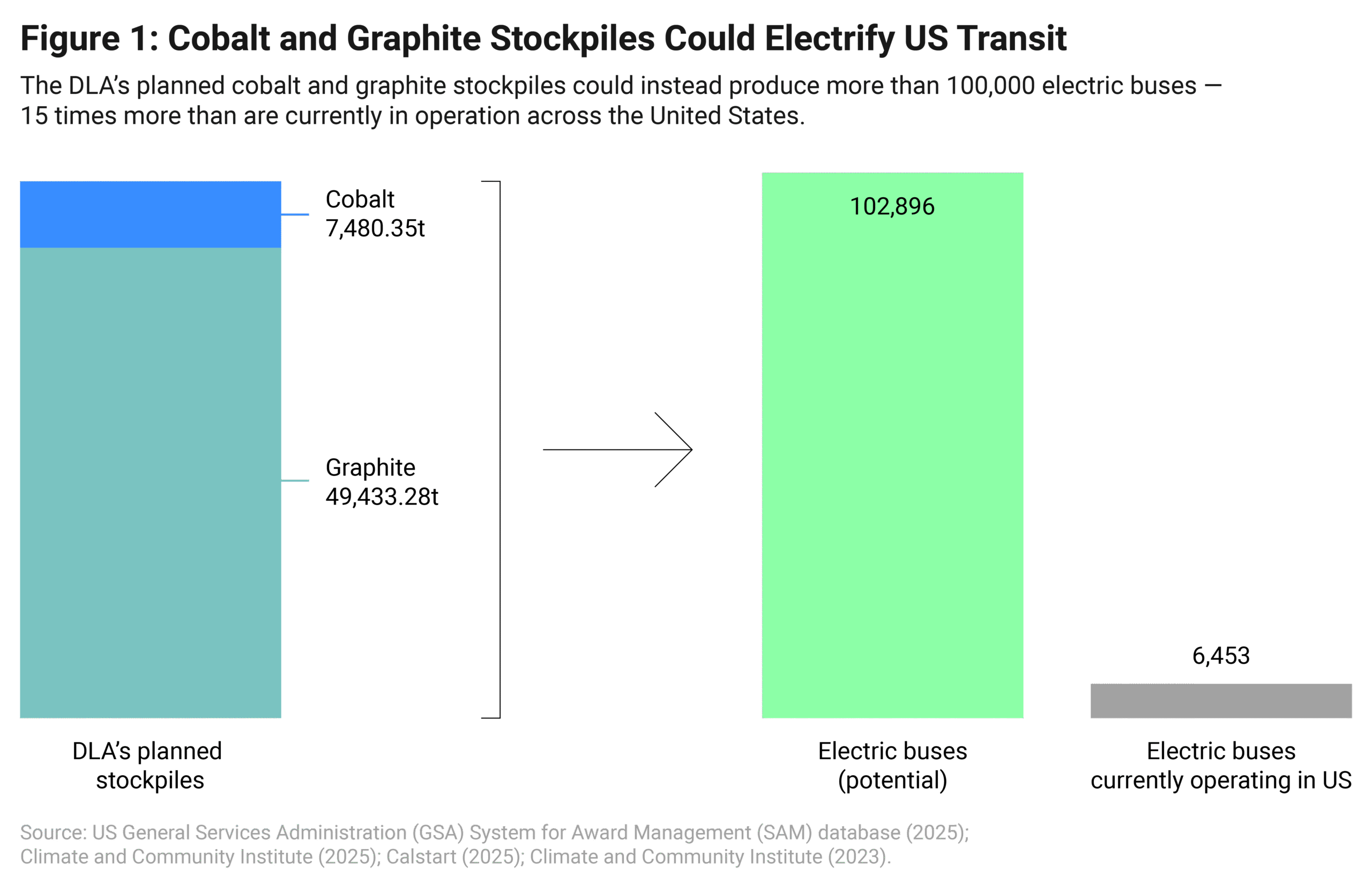
  • The DLA’s planned cobalt and graphite stockpiles could be used instead to produce approximately 100,000 electric buses — fifteen times more than are currently in operation across the United States.

The global transition to low carbon energy hinges on access to minerals which are vital components of renewable technologies. Estimates suggest that at least thirty energy transition minerals and metals (ETMs), such as lithium, cobalt, graphite and rare earth elements (REE), form the material basis of the energy transition. 1 Many of these same materials are also used to manufacture military technologies: everything from precision-guided weaponry and advanced communication systems to an emerging arsenal of military technologies such as AI-driven autonomous warfare platforms. Virtually every modern weapons system relies on mineral components. 2 The US government refers to these materials as “critical minerals”, where “criticality” is defined by a material’s economic or national security importance and susceptibility to supply disruptions. 3 Such designations authorize new modes of state intervention to ensure access and production, such as financial support, regulatory fast-tracking and other market-crafting efforts. 4 While there are overlaps, shorthanded in this briefing as “dual-use”, not all decidedly “critical” minerals are ETMs, nor are all ETMs captured within US critical mineral lists.

Beyond military applications, some of these same minerals are increasingly in demand for civilian technologies such as semiconductors, large-scale data centres and AI computing infrastructure, further intensifying competition for constrained supply chains. 5 As demand grows, global supply chains for these materials face mounting pressures, driven less by geological scarcity at present than by limited refining and processing capacity and the potential for future market volatility. In the United States, efforts to secure critical minerals are increasingly driven by concerns over China’s dominance in mineral markets and the perceived strategic vulnerabilities this creates amid intensifying great power rivalry — a posture that has not only persisted, but escalated across the first Trump, Biden, and now second Trump administrations. Washington is ramping up stockpiles, forging trade deals, investing in domestic production and even taking equity stakes in mineral companies to “onshore” supply and assert dominance over mineral supply chains. 6 By exerting control over the sourcing and distribution of critical minerals, the Pentagon is diverting materials away from civilian-led decarbonisation efforts while maintaining its role as the world’s largest consumer of fossil fuels and a major driver of climate change. 7

This briefing considers the US military’s role in driving extractive demand by analysing recent procurement activity by the Defense Logistics Agency (DLA), with a focus on critical and dual-use minerals. These materials are increasingly relevant not only to military supply chains and digitalisation but also to civilian renewable energy technologies, raising urgent questions about how resources are allocated and for what interests. Given the significant social and environmental harms associated with large-scale mining, mineral resources should be directed towards socially useful sectors. Advancing a just energy transition requires strong environmental regulation and enforcement, along with coordinated planning across sectors to support a sustainable industrial strategy, which centres equity, reduces emissions and directs public investment toward long-term green transformation. 8 By analysing recent trends in the DLA’s stockpiling of critical and dual-use minerals, this briefing demonstrates the US military’s expanding influence over mineral supply chains and associated risks to the energy transition and global resource governance.

Content Type
Theme

Militarised Mineral Supply Chains

The Pentagon is a major actor in mineral acquisition and planning, wielding outsized influence over domestic supply chains and in the global race for resources. This influence stems in part from the sheer scale of the US military. Sustained by a one trillion USD annual budget, the United States accounts for nearly 40 per cent of all military expenditures by countries around the world, spending more on war than the next nine countries combined. 9 At home, military spending also consumes a disproportionate share of public resources. The Pentagon accounts for over half of federal discretionary spending and nearly two-thirds of all federal contracting, with procurement contracts to private firms representing over half of military spending every year. 10 In 2022, 36 per cent of Pentagon contracts went to just five private companies major war profiteers: Boeing, Lockheed Martin, Northrop Grumman, General Dynamics and Raytheon. 11 Beyond these industry giants, the Pentagon purchases a vast array of other goods and services, everything from food, fuel and uniforms to high-tech surveillance technologies, accounting services and raw materials. This vast procurement machinery links US military planning to global extractive frontiers, intensifying demand pressures and influencing how and where resources are sourced.

In addition to its outsized scale and budget, the Pentagon exercises unique authorities relative to other agencies that allow it not only to influence mineral supply chains but to shape entire markets: absorbing risk, directing investments and creating demand signals that build strategic industrial capacity for military ends 12 Through mechanisms like DLA stockpiling and the Defense Production Act (DPA), the Pentagon directly procures raw materials and channels investment into selected mining and processing projects. 13 These powers give the military latitude to steer industrial development according to military objectives — often at the expense of environmental oversight. For example, President Trump’s 2025 Executive Order titled “Immediate Measures to Increase American Mineral Production”, which invokes the DPA to accelerate domestic mineral development, calls for the suspension of standard environmental review as required by the National Environmental Policy Act (NEPA). 14

According to a recent analysis of US public financing for mineral projects, the Pentagon has funded or signalled interest in supporting at least twenty mining initiatives in the US and Canada through DPA spending authorities, totalling nearly one billion USD since 2023. 15 In a striking example of this expanding market role, the US government has moved to take direct equity stakes in “critical mineral” companies — an unprecedented step in modern US industrial policy. 16 In July the Pentagon became the single largest shareholder in the United States’ only rare earths mine, purchasing 400 million USD in shares in the company MP Materials and negotiating a ten year offtake agreement, a contract to purchase a fixed portion of future production, backed by price supports to stabilise the market and guarantee returns. 17 The first in what has become a series of stakes in several companies, the tool not only shapes mineral supply chains but also consolidates the Pentagon’s control over them. 18

Another expression of the Pentagon’s expanding role in mineral supply chains is the revival of Cold War era stockpiling practices through the DLA. The US military’s primary logistics arm, it leverages purchasing power and contracting mechanisms to carry out procurement, storage, distribution and technical services. Established in 1961 at the height of the Cold War, the agency was created to centralise and streamline military supply operations as the United States expanded its global military footprint. One of its key functions became the management of the National Defense Stockpile (NDS), a reserve of non-fuel raw materials deemed essential for national security first established in 1939. 19 From the outset, stockpiling was explicitly tied to military readiness — the very notion of “criticality” emerged within this context, defined by a material’s strategic function and its vulnerability to supply shocks — criteria, and bellicose associations, that remain core to today’s critical mineral designations. 20

Although its role waned after the Cold War, the DLA’s stockpiling function has reemerged as the Pentagon seeks to secure critical minerals and reduce dependence on foreign, especially Chinese, sources. 21 The agency began reevaluating rare earth supply vulnerabilities as early as 2014 and more recently announced plans to procure and stockpile a suite of critical minerals amid an influx of funding from Trump’s Big Beautiful Bill (outlined in greater detail below). 22 Previously in 2022, the Departments of Energy, State and Defense signed an interagency agreement to begin stockpiling materials to “support the U.S. transition to clean energy and national security needs”, a move justified as enhancing “American energy security and 21st century competitiveness.” 23 Yet even when cast in broader terms, disbursements through the NDS remain structurally oriented toward military priorities, limiting their deployment to the wider civilian economy. Materials in the NDS can only be released by the president in times of declared war or if otherwise deemed necessary “to serve the interest of national defense only.” 24

The revival of stockpiling practices has unfolded alongside a broader shift in how ETMs are framed across news, policy and industry communications. With a growing emphasis on urgency, scarcity and looming military threats, securing mineral supply chains is increasingly portrayed as essential to geopolitical security and a pathway to economic stability. This policy and industry-driven framing fosters a “growth at any cost” mentality that undermines regulation, standard-setting, multilateral cooperation, long-term perspectives and broad notions of rights and responsibilities — all key tenets of a just energy transition. 25 The narrative aligns with the material interests of multinational mining corporations, weapons manufacturers and other financial stakeholders who stand to profit from unchecked extraction, whether under the banner of national security or the energy transition. While there is no immediate shortfall of most ETMs, military demand for key transition minerals risks diverting materials from civilian decarbonisation needs and inflating long-term demand projections, a dynamic that risks accelerating mining expansion, even in the absence of near-term scarcity. 26

Additionally, the extraction of critical minerals has profound environmental and social costs. In the absence of robust recycling systems, growing demand for critical minerals drives new mining ventures in a global industry notorious for disastrous environmental, human, worker and Indigenous rights violations. 27 Mining operations often flatten entire ecosystems, generating massive volumes of toxic waste and contaminating soil and water — pollution that can persist long after a mine is closed with disastrous implications for human and environmental health. 28 The harms inflicted at sites where raw materials for weapons are extracted prefigure similar patterns of ecological devastation and public health crisis that occur at every stage of a weapon’s lifecycle, from manufacturing and testing to deployment and disposal. 29 In other words, the ecological devastation and toxic legacies caused by military technologies begins with raw material extraction and persists throughout at every stage of their lifecycle of destruction.

The merging of geopolitical threats with business interests, used to justify the military’s growing demand for so-called critical and dual-use minerals, reflects a broader problem of material capture in which resources and state capacity are directed toward military priorities. 30 Diverting materials away from essential civilian uses like renewable energy infrastructure, risks slowing decarbonisation efforts at a time when rapid action is crucial. Moreover, stockpiling fuels a dangerous dynamic of military competition, where access to materials becomes a geopolitical contest decided by force rather than a shared resource for the global energy transition. By capturing these materials to fuel the war machine, the Pentagon not only drains resources needed for urgent climate solutions but also perpetuates a destructive cycle of militarism that undermines global peace and sustainability while crowding out the civilian functions of the federal government. This misplaced prioritisation threatens both the planet’s future and the possibility of a just, collaborative energy transition that benefits all people rather than narrow military interests.

The Growing Military Mineral Stockpile

Materials profiled in this briefing reflect emerging stockpiling priorities and trends as well as their relevance to both military supply chains and civilian clean energy technologies. This analysis reviews recent procurement activity by the DLA, with a focus on contract awards and solicitations related to critical minerals as listed by the federal government’s System for Award Management.

The DLA’s contracting behaviour provides a useful, though incomplete, window into how military priorities clash with broader resource needs for the energy transition. 31 A significant portion of materials used to produce weapons and other military infrastructure flows through private weapons manufacturers, whose operations are largely shielded from public scrutiny. This flow of materials into military infrastructure — including surveillance systems, weapons platforms, and fossil-fuelled war machines — remains largely undocumented. There is no publicly available accounting of military demand for key minerals essential to the energy transition. This lack of transparency constitutes a major accountability gap, obscuring military resource consumption, representing a barrier to justice-based transition planning.

Despite these limitations, analysis of recent DLA activity demonstrates emerging priorities in stockpiling dual-use minerals, highlighting the US military’s role in supply chains vital to both military and energy transition technologies. The DLA stockpiles about 48 minerals and alloys in six depots across the United States. 32 Trump’s Big Beautiful Bill earmarked 7.5 billion USD for critical minerals, including two million USD specifically for the NDS. 33 The table below 34  outlines DLA stockpiling contracts and solicitations since the passage of the Bill.

As noted in the table, many of the materials included in the DLA’s recent stockpiling activities are not materials typically considered essential to the energy transition. Rather than aligning with climate or renewable energy goals, the DLA’s stockpiling priorities are driven by national defence imperatives. 35 However, many of the same materials in the NDS could be used to support the rapid deployment of renewable energy technologies and advance broader decarbonisation goals. Cobalt and graphite, for example, are key ETMs, used extensively in battery technologies that power electric vehicles and enable large-scale energy storage, both critical components of the energy transition. 36 The amount of cobalt and graphite the DLA has recently solicited for the National Defense Stockpile could supply the cobalt and graphite needed to manufacture over 100,000 electric buses — a substantial share of the fleet required to reorder the US transportation system to prioritise electrified public transit over car dependency. 37 Today, fewer than 6,500 electric buses are in operation nationwide. 38
Moreover, grid-scale battery storage, which plays a critical role in stabilising the electricity grid by storing and dispatching excess energy from variable renewable sources like wind and solar, will need to grow significantly to support the energy transition. At the same time, battery storage systems are mineral intensive. 39 Compared to the 1015.23t of cobalt that went to battery storage in 2024, the nearly 7,500t of cobalt slated for the DLA stockpile could be used instead to produce 80.2 gigawatt hours of battery capacity — more than double existing energy storage. 40 This highlights the significant potential for these materials to accelerate clean energy deployment.
Military demand for transition minerals could also drive new forms of ecological destruction by accelerating harmful extractive practices. Deep-sea mining, a relatively untested method of extracting metals from the ocean floor, is gaining global momentum despite widespread concerns about its environmental risks and unproven benefits. 41 In March 2025, the US federal government escalated its pursuit of deep-sea mining by partnering with The Metals Company (TMC) to commercially explore mining in the international seabed, justifying the move as necessary to secure supply chains for military technologies and strategic autonomy while bypassing ongoing multilateral negotiations. 42 The move was followed by an executive order signalling intent to “restore American dominance in offshore critical minerals and resources.” 43 The multi-billion dollar push for deep-sea mining relies on overstated claims about material scarcity, social benefits and economic gains. 44 Far from responding to real need, the latest push for deep-sea mining is entangled in opportunistic industry attempts to capitalise on geopolitical volatility and present deep-sea mining as a US national security imperative, a move that itself could heighten global insecurity and provoke new conflicts. 45 Circumventing international law undermines multilateral governance and risks intensifying competition over contested waters, escalating conflict in the Pacific and turning the international seabed into a contested arena of resource extraction and strategic competition — a dynamic which has been described as a “literal race to the bottom.” 46

Beyond Military and Mineral Dominance

The Pentagon’s demand for critical and dual-use minerals skews global mineral supply chains toward military interests. In a context where mining is constrained to meeting socially useful and needed purposes — prioritising rapid decarbonisation while minimising the harms of extraction — channelling minerals and metals to the military diverts resources from necessary civilian uses. This diversion slows progress towards a sustainable and equitable energy future: the materials essential to the energy transition should accelerate decarbonisation, not feed an insatiable war machine. At a time when collective action is crucial to confront climate crisis, the expansion of militarised mineral supply chains deepens geopolitical competition and privileges militarised forms of security over collective wellbeing. 47 True security lies not in military or “mineral dominance”, but in building systems that sustain both people and the planet.

Recommended policy approaches

1

Curb excessive demand

Implement policies that promote recycling and reduce mineral demand overall. Regulate and reduce demand from sectors with high mineral intensity and environmental impact, such as military activities and data centres, to alleviate pressure on transition mineral resources.

2

Embed justice and accountability

Enforce labour, environmental and Free, Prior and Informed Consent (FPIC) conditions on all public procurement contracts for minerals and technologies, promoting social and ecological responsibility throughout supply chains.

3

Democratise resource governance

Establish transparent, civilian-led industrial policy tools to stabilise markets, safeguard supplies, serve the public interest and ensure equitable access to transition minerals. Reform emergency powers to align with civilian climate goals.

4

Foster global solidarity

Build international cooperation, including coordination with China on climate technology collaboration to reduce duplication in supply chains, lower mining demand and ease geopolitical tensions impacting mineral markets.

The author would like to acknowledge several colleagues who contributed to this briefing. Thank you to the reviewers of this briefing for their valuable feedback, including Brytnee L. M. and Thea Riofrancos. Khem Rogaly and Patrick Bigger provided key insights and feedback on this research. Lucy Block advised on data visualisation. Amelia Horgan contributed copyediting and Sophie Monk provided data visualisation.

  1. 1.
    Oli Brown, Sebastian Dunnett, Elizabeth Steyn and Claudia S. De Windt, “Critical Transitions: Circularity, equity, and responsibility in the quest for energy transition minerals”, United Nations Environment Programme, 18 November 2024, available here; Daniele La Porta Arrobas, John Richard Drexhage, Thao Phuong Fabregas Masllovet and Kirsten Lori Hund, “Minerals for Climate Action: The Mineral Intensity of the Clean Energy Transition”, World Bank Group, 25 May 2023, available here; John R. Owen, Deanna Kemp, Alex M. Lechner, Jill Harris, Ruilian Zhang and Éléonore Lèbre, “Energy transition minerals and their intersection with land-connected peoples”, Nature Sustainability, 2023, volume 6, pp. 203–211.
  2. 2.
    Vlado Vivod, Ron Matthews and Jensine Andresen, “Securing defense critical minerals: Challenges and U.S. strategic responses in an evolving geopolitical landscape”, Comparative Strategy, 2025, Volume 44; Mark Griffiths and Kali Rubaii, “Late modern war and the geos: The ecological ‘beforemaths’ of advanced military technologies”, Security Dialogue, 2025, Volume 56, pp. 38-57; Benedetta Girardi, Irina Patrahau, Giovanni Cisco and Michel Rademaker, “Strategic raw materials for defence: Mapping European industry needs”, Hague Centre for Strategic Studies, 2023, available here.
  3. 3.
    See: U.S. Geological Survey, “What is a critical mineral?”, U.S. Department of the Interior, 30 September 2025, available here.
  4. 4.
    Adrienne Buller and Thea Riofrancos, “Where Capital and Nature Meet,” The Breakdown, 22 September 2025, available here; Cleodie Rickard and Laura Bannister, “Material realities: Who needs ‘critical minerals’ and at whose expense?”, Global Justice Now, 6 August 2025, available here; Ian Morse, “Communicating the Energy Transition: A Literature Review of Public Discourse and Narratives About Energy Transition Materials”, Harmony Labs, June 2025, available here
  5. 5.
    Annie Lee and Mark Burton, “Copper Hits a Record as Supply Snarls Set the Stage for Deficits”, Bloomberg, 28 October 2025, available here; Katharine Gemmell, “Copper Records Biggest Weekly Gain Since June on Supply Shortage”, Bloomberg, 25 September 2025, available here
  6. 6.
    Thea Riofrancos, “The ‘critical minerals’ rush could result in a resource war”, Financial Times, 12 March 2025, available here; Emily Iona Stewart, “Material realities: Who needs ‘critical minerals’ and at whose expense?”, Global Witness, 20 March 2025, available here; Jiayi Zhou and André Månberger, “Critical Minerals and Great Power Competition: An Overview”, SIPRI, October 2024, available here.
  7. 7.
    Patrick Bigger, Nick Pearce, Khem Rogaly, and Ketaki Zodgekar, “Less War, Less Warming: A Reparative Approach to US and UK Military Ecological Damages”, Common Wealth and Climate and Community Institute, 2023, available here.
  8. 8.
    Isabel Estevez and Thea Riofrancos, “Global Green Industrial Policy”, Climate and Community Institute, 2025, available here
  9. 9.
    Xiao Liang, Nan Tian, Dr Diego Lopes da Silva, Lorenzo Scarazzato, Zubaida A. Karim, Jade Guiberteau Ricard, “Trends in World Military Expenditure”, SIPRI, April 2025, available here.
  10. 10.
    Rodrigo Carril and Mark Duggan, “The impact of industry consolidation on government procurement: Evidence from Department of Defense contracting”, Journal of Public Economics, 2020, Vol 184; William D. Hartung and Stephen Semler, “Profits of War: Top Beneficiaries of Pentagon Spending, 2020 – 2024, Quincy Institute for Responsible Statecraft and Costs of War at Brown University’s Watson School of International and Public Affairs, 2025, available here
  11. 11.
    Zaynab Quadri, “Anatomy of a Defense Budget”, Phenomenal World, 27 March 2025, available here.
  12. 12.
    Mariana Mazzucato, The Entrepreneurial State: Debunking Public vs. Private Sector Myths, Anthem Press: 2013, pp 95-107.
  13. 13.
    The Defense Production Act is a US law which empowers the President with a broad set of authorities to influence domestic industry in the interest of national defense, see: Alexandra G. Neenan, “The Defense Production Act of 1950: History, Authorities, and Considerations for Congress”, Congressional Research Service, 6 October 2023, available here.
  14. 14.
    Both the Trump and Biden administrations invoked the DPA to fund critical mineral supply chains. The Biden administration’s earlier DPA actions in 2022 focused on expanding domestic sourcing by providing the Pentagon with more administrative leverage to approve mineral project funding.
  15. 15.
    Cristian Barrios, “Issue Brief: Growing U.S. Public Financing For Minerals Projects”, Friends of the Earth, available here.
  16. 16.
    Hannah Northey, “Inside Trump’s foray into mineral ownership”, E & E News by Politico, 8 October 2025, available here.
  17. 17.
    Matthew Zeitlin, “The Pentagon’s Rare Earths Deal Is Making Former Biden Officials Jealous”, Heatmap, 11 July 2025, available here; Thea Riofrancos, “Trump’s resource nationalism is the worst of all worlds”, Financial Times, 3 September 2025, available here.
  18. 18.
    Reuters, “Trump administration pivots to buying stakes in critical sectors”, Reuters, 7 October 2025, available here; Amanda Follett Hosgood, “Why Is the US War Department Buying into a BC Mining Company?”, The Tyee, 16 October 2025, available here.
  19. 19.
    The National Defense Stockpile was first established in 1939 to retain stocks of strategic and critical materials to “serve the interest of national defense only,” defining strategic and critical materials as those that “(A) would be needed to supply the military, industrial, and essential civilian needs of the United States during a national emergency, and (B) are not found or produced in the United States in sufficient quantities to meet such need,” see: “Strategic and Critical Materials Stock Piling Act”, U.S. Government Publishing Office, 23 January 2024, available here.
  20. 20.
    The concept of critical and strategic minerals can be traced back to at least the first World War, when many of the involved nations began to experience shortages of materials essential to sustaining the war effort and began to institutionalise efforts to secure supplies. In the United States, the Army and Navy Munitions Board was established in the US Department of War in 1922 to acquire and stockpile materials, Anton R. Chakhmouradian, Martin P. Smith and Jindrich Kynicky, “From “strategic” tungsten to “green” neodymium: A century of critical metals at a glance,” Ore Geology Reviews, 2015, Volume 64, Pages 455-458; see also: Megan Black, The Global Interior: Mineral Frontiers and American Power, “(Harvard University Press: 2018, 68–83. For additional analysis on the historic dynamics of military mobilisations and the emergence of critical minerals, see: Philip Johnstone and Anabel Marin, “Beyond the twin transition: military drivers of critical minerals’ expansion”, Institute of Development Studies (IDS), forthcoming.
  21. 21.
    Daniel F. Runde and Austin Hardman, “Elevating the Role of Critical Minerals for Development and Security”, Center for Strategic & International Studies, 2023, available here; Marc Humphries, “Critical Minerals and U.S. Public Policy”, Congressional Research Service, 28 June 2019, available here; Vivian Chime, “Trump follows the minerals trail — but for weapons, not clean energy”, Climate Change News, 4 April 2025, available here; “Strategic and Critical Materials Stock Piling Act”, International Energy Agency, 31 October 2022, available here.
  22. 22.
    U.S. Government Accountability Office, “Rare Earth Materials: Developing a Comprehensive Approach Could Help DOD Better Manage National Security Risks in the Supply Chain”, U.S. Government Accountability Office, 11 February 2016, available here; U.S. Department of Defense, Office of Inspector General, “Procedures to Ensure Sufficient Rare Earth Elements for the Defense Industrial Base Need Improvement”, U.S. Department of Defense, 3 July 2014, available here; Camilla Hodgson, Steff Chávez and Aime Williams, “Pentagon steps up stockpiling of critical minerals with $1bn buying spree”, Financial Times, 11 October 2025, available here; Jack Farchy, Joe Deaux, and Annie Lee, “US Seeks $500 Million Cobalt Stash, First Buy Since Cold War”, Bloomberg, 21 August 2025, available here.
  23. 23.
    Office of International Affairs, “U.S. Departments of Energy, State and Defense to Launch Effort to Enhance National Defense Stockpile with Critical Minerals for Clean Energy Technologies”, U,S, Department of Energy, 25 February 2022, available here; Reed Blakemore, Alexis Harmon and Peter Engelke, “Critical minerals in crisis: Stress testing US supply chains against shocks”, Atlantic Council, 9 October 2025, available here.
  24. 24.
    See: Cameron M. Keys, “Emergency Access to Strategic and Critical Materials: The National Defense Stockpile,” Congressional Research Service, 14 November 2023, available here; “Strategic and Critical Materials Stock Piling Act (Amended through FY 2024)”, Defense Logistics Agency, 2024, available here; In the press release announcing the MOA, for example, Deputy Secretary of Defense Kathleen Hicks frames the energy storage in “creating new advantages for our warfighters,” see: Office of International Affairs, “U.S. Departments of Energy, State and Defense to Launch Effort to Enhance National Defense Stockpile with Critical Minerals for Clean Energy Technologies“, U,S, Department of Energy, available here.
  25. 25.
    “Energy Transition Materials Narrative Landscape: Across news, industry, and policy information domains in Canada, Chile, DRC, Germany, Indonesia, Mexico, Peru, Portugal, USA, Findings Summary”, Harmony Labs, August 2025, available here.
  26. 26.
    Dr. Tom Moerenhout, Lilly Yejin Lee, and Dr. James Glynn, “Critical Mineral Supply Constraints and Their Impact on Energy System Models”, Center on Global Energy Policy at Columbia, 12 June 2023, available here; IEA, “Overview of outlook for key minerals – Global Critical Minerals Outlook 2025”, IEA, 2025, available here; Justin Alger, Jessica F. Green, Kate J. Neville, Susan Park, Stacy D. VanDeveer, and D. G. Webster, “The false promise of deep‑sea mining”, NPJ Ocean Sustainability, 2025, volume 4.
  27. 27.
    John R. Owen, Deanna Kemp, Jill Harris, Alex M. Lechner and Éléonore Lèbre, “Fast track to failure? Energy transition minerals and the future of consultation and consent,” Energy Research & Social Science, 2022, Volume 89; Arnim Scheidel, Daniela Del Bene, Juan Liu, Grettel Navas, Sara Mingorría, Federico Demaria, Sofía Avila, et al., “Environmental conflicts and defenders: A global overview,” Global Environmental Change, 2020, Volume 63.
  28. 28.
    Daan Van Brusselen, Tony Kayembe-Kitenge, Sébastien Mbuyi-Musanzayi, Toni Lubala Kasole, Leon Kabamba Ngombe, Paul Musa Obadia, Daniel Kyanika Wa Mukoma, et al., “Metal mining and birth defects: a case-control study in Lubumbashi, Democratic Republic of the Congo,” Lancet Planet Health, 2020, Volume 4.
  29. 29.
    Michael J. Lawrence, Holly L.J. Stemberger, Aaron J. Zolderdo, Daniel P. Struthers and Steven J. Cooke, “The effects of modern war and military activities on biodiversity and the environment”, Environmental Reviews, 2015, volume 23; Griffiths and Rubaii, “Late modern war and the geos: The ecological ‘beforemaths’ of advanced military technologies”, Security Dialogue, pp 38-57; Reuben Larbi, Kali Rubaii, Benjamin Neimark and Kirsti Ashworth, “Parting the Fog of War: Assessing Military Greenhouse Gas Emissions from Below”, The Extractive Industries and Society, 2025, Vol. 23; Amira Aker, John Doe, Jane Smith, Michael Brown, Lisa Taylor, Robert Johnson, Emily Davis, et al., “The Ongoing Environmental Destruction and Degradation of Gaza: The Resulting Public Health Crisis”, American Journal of Public Health, 2025, Vol. 115, pp. 1053–1061.
  30. 30.
    “Energy Transition Materials Narrative Landscape: Across news, industry, and policy information domains in Canada, Chile, DRC, Germany, Indonesia, Mexico, Peru, Portugal, USA, Findings Summary”, Harmony Labs, available here.
  31. 31.
    In terms of transparency, stockpiling materials through the DLA offers a higher level of public visibility and scrutiny than direct procurement by military contractors. Direct contractor purchases often have limited visibility, whereas materials procured by the DLA and subsequently distributed are likely to appear in public databases, providing more accessible information on these flows.
  32. 32.
    Stew Magnuson, “Defense Logistics Agency Considers Dipping into Strategic Mineral Stockpiles,” National Defense, 20 June 2025, available here.
  33. 33.
    Hodgson, Chávez and Williams, “Pentagon steps up stockpiling of critical minerals with $1bn buying spree”, Financial Times, available here.
  34. 34.
    Material quantities are based on solicitations published in the U.S. General Services Administration (GSA) System for Award Management (SAM) database (sam.gov) between July 4, 2025, and November 7, 2025, “System for Award Management (SAM)”, U.S. General Services  Administration, 2025, available here.
  35. 35.
    “Strategic and Critical Materials Stock Piling Act”, International Energy Agency, available here.
  36. 36.
    Tae-Yoon Kim, Eric Buisson, Amrita Dasgupta, Shobhan Dhir, Félix Gagnon, Alexandra Hegarty, Gyubin Hwang, et al., “Global Critical Minerals Outlook 2025”, International Energy Agency (IEA), 21 May 2025, available here.
  37. 37.
    Lorah Steichen, Mekedas Belayneh, Matthew Haugen, Patrick Bigger and Lucy Block, “Redirecting Energy Transition Minerals from the Pentagon Fleet to the Public Good”, Climate and Community Institute, February 2025, available here; Thea Riofrancos, Alissa Kendall, Kristi K. Dayemo, Matthew Haugen, Kira McDonald, Batul Hassan and Margaret Slattery, “Achieving Zero Emissions with More Mobility and Less Mining”, Climate and Community Institute, January 2023, available here.
  38. 38.
    Mike Hynes and Kaila Lemons, “Zeroing in on Zero-Emission Buses The U.S. Advanced Technology Transit Bus Index”, Calstart, March 2025, available here.
  39. 39.
    “Mineral requirements for clean energy transitions”, IEA, 2021, available here.
  40. 40.
    According to IEA’s Critical Minerals Dataset, 4060.92 metric tonnes of cobalt are used for global grid battery storage as of 2024. According to IEA’s Global Critical Minerals Outlook, the United States accounts for a quarter of global demand. According to the US Energy Storage Monitor report, there was 37.143 GWh energy storage deployed in the US in 2024. Quantification based on the mid-range material intensity of cobalt per stationary storage lithium-ion battery as published by the US Department of Energy Critical Materials Assessment. See: International Energy Agency, “Critical Minerals Dataset”, IEA May 2025, available here; Kim, Buisson, Dasgupta, Dhir, Gagnon, Hegarty, Hwang, et al., “Global Critical Minerals Outlook 2025”, International Energy Agency, available here; “REPORT: Energy Storage’s Meteoric Rise Breaks Another Record”, American Clean Power Association (ACP) and Wood Mackenzie, March 2025, available here; “Critical Materials Assessment”, U.S. Department of Energy, May 2023, available here.
  41. 41.
    Bernd Christiansen, Anneke Denda and Sabine Christiansen, “Potential effects of deep seabed mining on pelagic and benthopelagic biota,” Marine Policy, 2020, Volume 114.
  42. 42.
    Elizabeth Claire Alberts, “A sales-pitch pivot brings deep-sea mining closer to reality”, Mongabay, 31 July 2025, available here; Psyche 16, Antoine Gillod, Tom Cariou, Andrew Thaler, Arlo Hemphill, Jackie Dragon, John Hocevar, et al., “Deep Deception How The Deep Sea Mining Industry Is Manipulating Geopolitics To Profit From Ocean Destruction,” Greenpeace, 2025, available here.
  43. 43.
    “Fact Sheet: President Donald J. Trump Unleashes America’s Offshore Critical Minerals and Resources”, The White House, 24 April 2025, available here.
  44. 44.
    Justin Alger, Jessica F. Green, Kate J. Neville, Susan Park, Stacy D. Van Deveer and D. G. Webster, “The false promise of deep-sea mining,” npj Ocean Sustain, 2025, 4.
  45. 45.
    Evan Halper and Jake Spring, “Trump moves to open seabed to mining, unnerving other nations,” Washington Post, 24 April 2025, available here. Psyche 16, et al., “Deep Deception How The Deep Sea Mining Industry Is Manipulating Geopolitics To Profit From Ocean Destruction,” Greenpeace, available here.
  46. 46.
    Alberts, “A sales-pitch pivot brings deep-sea mining closer to reality,” Mongabay, available here.
  47. 47.
    Tobita Chow, “Cold War on a Warming World”, Transition Security Project, available here.